Anthony Caro in the early 1960s
Anthony Caro in the early 1960s: Between High Modernism and New Brutalism
By John J. Curley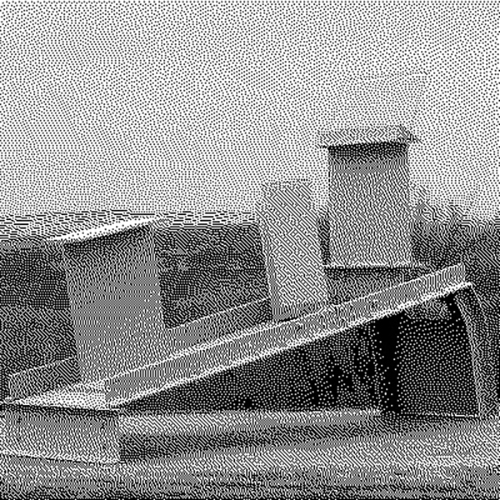
Abstract
This article focuses on Anthony Caro’s painted steel works of the early 1960s that were championed by Clement Greenberg and Michael Fried. I argue that the resulting Americanization simplified the reception of the sculptures and repressed their complex relationship to their London-specific context. In the 1950s Caro’s weighty figurative sculptures were influenced by theories of new brutalism advocated by his friends (and Independent Group members) Nigel Henderson, Eduardo Paolozzi, and Alison and Peter Smithson—specifically, their ideas of repurposing “as found” materials and material honesty. Using period criticism, archival evidence, and close formal analysis, the article shows that these new brutalist ideas were also operating in his painted steel works. Reading Caro’s sculptures as transatlantic hybrids allows us to see his 1960s works as complex mediators between theories of new brutalism and the critical models of modernist purity established by Greenberg and Fried—as Trojan horses smuggling the material and social concerns of postwar London reconstruction into the discourse of American high modernism. In other words, these canonical sculptures can simultaneously suggest aesthetic transcendence and the contingency and politics of everyday life.
Introduction
In 1961 the art critic David Sylvester had an unusual experience with one of Anthony Caro’s painted steel sculptures. Some years later, he recalled:
1The Horse, of 1961, had been the dominant piece in the second Situation group show organized by Lawrence Alloway. I had visited the exhibition on a Saturday morning with my two year old daughter, and when I encouraged her, in the presence of other visitors I knew to climb onto the Caro and walk up and down the slope, it had not only been to show the pretty child off and keep her entertained; it had been a deliberate act of provocation directed against my friend and enemy Alloway: I treated the piece as a piece of a playground apparatus to imply that it was an object rather than a sculpture.1
The display of The Horse in The New London Situation was Caro’s first publicly exhibited painted steel work and, at this foundational moment, it was a site for interactive and physical play (fig. 1).2 The show, subtitled “An Exhibition of British Abstract Art” and curated by Alloway, presented abstract works that, for the curator, were optical—not physical—in conception. The Horse and Sylvester’s anecdote are a fitting way to begin, as together they suggest both an embrace and a rejection of American high modernism.
2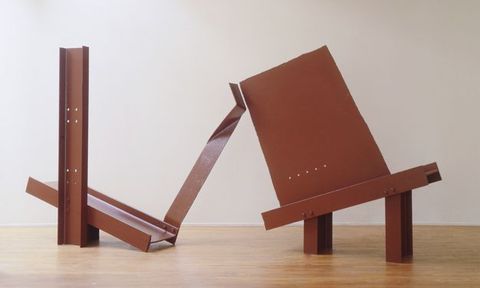
Alloway’s emphasis on the optical qualities of the works in The New London Situation bears the stamp of the influence of the American critic Clement Greenberg, whom Alloway met in the United States in the 1950s.3 Throughout that decade, Greenberg wielded considerable influence championing abstract works that prioritized visual experience over other concerns. Similarly, Caro’s sculptural practice underwent a dramatic transformation that Greenberg also helped to shape. After serving as an assistant to Henry Moore from 1951 to 1953 and making weighty and expressive figurative sculptures that conform to the older artist’s notions of carving stone or casting bronze, Caro invited Greenberg to his Hampstead studio in 1959. After the critic told the artist that his sculptures were “not up to the mark”, Caro traveled to the United States and Mexico for two months, where he immersed himself in Greenberg’s circle of artists—Jules Olitski, Helen Frankenthaler, and especially Kenneth Noland, who became a close friend.4 Caro was particularly taken with how the American artists employed bright colors.5 He also encountered the welded work of David Smith on this trip to New York, specifically an example from his totemic Sentinel series from the mid-1950s. The two sculptors met at a dinner party on that trip but, according to Caro, he did not visit Smith’s Terminal Iron Works studio in upstate New York until his return visit to the United States in 1963. (There are conflicting accounts, however, about when Caro first visited the studio.)6 Upon his return to London, Caro radically transformed his practice, rejecting carved or cast monoliths and embracing the open refinement of welding painted steel components to construct sculptures such as The Horse. He then displayed the results directly on the floor—rejecting traditional pedestals.7
3Both Greenberg and his young acolyte Michael Fried began to champion Caro in the early 1960s. While Greenberg’s and Fried’s specific understandings of Caro’s work differ, both are predicated on notions of transcendence. Greenberg appreciated the way Caro’s constructions make their heavy steel components appear nearly weightless; Fried praised how Caro’s sculptures from this period avoid theatrical effects by using abstract forms that suggest a pure model of communication representing an ideal that humans can only strive toward.8 While neither critic discussed The Horse, its optical presence is hard to miss. Its verticals and diagonals mimic neat and regularized brushstrokes in space, and its flat plane facing the viewer seemingly defies gravity by not crashing to the ground.
8This understanding of Caro is consistent with what was eventually called “high modernism”—a period from around the end of the 1950s until 1967 when, as the art critic Barbara Rose noted, there was a “widespread assault on the dogma of modernism”.9 While Greenberg and Fried never used this specific term in the 1960s, later writers, beginning in the early 1990s, employed it as shorthand for the critical project and artistic tendency championed by these critics.10 In addition to highlighting the optical and formal experience of a work over its social or political content, high modernist critics privileged the artwork’s autonomy from external concerns, and expressed a belief in the historical trajectory of modernist art—especially how works build on one another to achieve an ever-greater formal refinement. “High modernism” became synonymous with this critical framework and the actual practices of the artists associated with this term, such as Morris Louis, Kenneth Noland, and Caro. This article attempts to explode the conflation: Caro’s painted steel sculptures engage a high modernist critical discourse but also remain embedded in distinctly London-based contexts that are antithetical to these ideas.11
9The anecdote about Sylvester’s daughter and The Horse reveals qualities at odds with high modernism. Her interaction transformed the work into a contingent and physically interactive sculpture, qualities that directly challenge the artistic autonomy that was central to American high modernism. This reframing reveals the playful seriousness and engagement with raw materials that were characteristic of new brutalism, a London-based movement, centered around Reyner Banham and a faction of the Independent Group, that bridged art and architecture in the 1950s and sought to create new forms of social engagement for postwar society. The Horse’s salvaged steel scraps—including at least three I-beams—connote labor and toil, and the dull paint does little to transform the material’s industrial identity.12 Furthermore, the empty bolt holes, seen in the flat steel at left and in the vertical beam standing on the right, suggest the metal’s original architectural or engineering functions. Some years after the fact, Caro’s student William Tucker discussed his first impression of Caro from the early 1960s: “You know, we thought he was a kind of found-object sculptor”.13
12Despite important interventions by commentators including Alloway in Artforum in 1975, David Mellor in his exhibition catalogue The Sixties Art Scene in London in 1993, and Alex Potts in a 2012 essay, Caro’s work remains either largely tied to American discourses of high modernism and the precedent of welded sculpture set by David Smith, or subject to insular biographical accounts of formal developments across his career.14 As Julius Bryant noted, “The literature around Caro is so extensive that many clichés have become part of how we ‘read’ and understand his art”.15 This article argues that Caro’s painted steel works must be read as transatlantic hybrids: sculptures that embrace American high modernist principles while engaging with new brutalist practices rooted in London’s cultural context of the 1950s and beyond. In excavating the history relating to Caro’s development in the 1950s and early 1960s, I hope to resituate the artist as a complex mediator of diverse and ostensibly contradictory traditions. By this logic, The Horse can both compel the modernist conviction associated with Greenberg/Fried and address the broader social and urban concerns of the new brutalists. And, given how the work’s uniform cover of paint and elegant composition attempt to hide the steel’s quotidian function, the horse of the title might be a Trojan one, with Caro smuggling industrial readymade materiality within forms that became associated with American high modernism.
14Caro and New Brutalism in the 1950s
Caro’s biographer Ian Barker mentions the artist’s ties to certain members of the Independent Group in the 1950s, namely the faction composed of Eduardo Paolozzi, Nigel Henderson, and the architects Alison and Peter Smithson.16 Caro befriended the Smithsons while studying sculpture at the Royal Academy Schools in London from 1947 to 1952; the Smithsons then introduced Caro to Henderson and Paolozzi. This branch of the Independent Group not only organized the seminal exhibition of found photography, Parallel of Life and Art, in 1953 but also the memorable Patio and Pavilion section of This Is Tomorrow in 1956, which incorporated architecture, sculpture, and photomontage.17 The foursome, along with the architectural critic Reyner Banham, were also associated with the ideas and theories of new brutalism. Scholars have not, however, adequately explored how Caro’s friendships affected his sculptures of the 1950s and early 1960s.
16Parallel of Life and Art made a strong impression on Caro, according to Barker.18 The organizers took “found” photographs—excised from art serials, popular picture magazines, scientific journals, newspapers, and other sources—and enlarged them to create a chaotic all-over environment. In one installation view, for instance, an image of a head carved from whalebone hangs near a microscopic cross-section of a plant (fig. 2). Banham highlighted these two photographs in his 1953 review of the show: “They come from societies and technologies almost unimaginably different, and yet to camera-eyed western man the visual equivalence is unmistakable and perfectly convincing”.19 The show dramatized how Caro’s friends Henderson, Paolozzi, and the Smithsons appropriated and enlarged readymade, found images to defamiliarize them and to disorient the viewer. Photography might be a concrete referent to the world but it could also allow for open modes of interpretation.20
18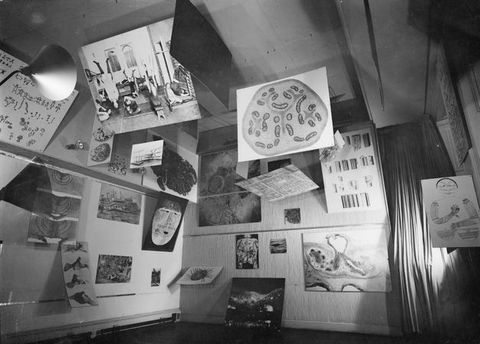
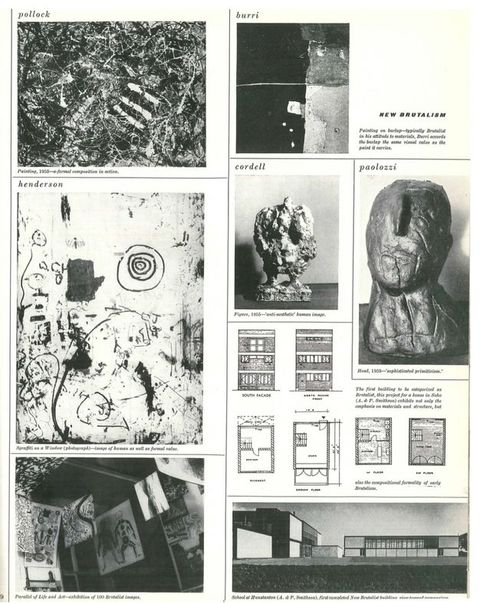
An image from Parallel of Life and Art appeared in an article about new brutalism by Banham, published in The Architectural Review in late 1955 (fig. 3). Banham also selected other images for the page from both the United States and Europe, including a detail of a painting by Jackson Pollock, a sackcloth work of Alberto Burri, and a Henderson photograph of found sgraffito. Parallel of Life and Art, as well as appropriating objects and images more generally, was of crucial importance to Banham’s understanding of new brutalist architecture—represented here (lower right in fig. 3) with images of plans for the Smithsons’ Soho House project in London and a photograph of their completed Hunstanton School in Norfolk. What could possibly link these disparate images for Banham—a violently ripped and sutured canvas, a drip painting, and a geometrically modern building reminiscent of Mies van der Rohe? For the critic, “what moves a New Brutalist is the thing itself, in its totality, and with all its overtones of human association”.21 And this “thing itself” would be raw and expressive; an aesthetic of anti-beauty is the guiding principle that links the photographs on this magazine page.22
21The diversity of the article’s pictures suggests that, for Banham, new brutalism was full of contradictions. As Ben Highmore has discussed in his thoughtful book on the subject, the aesthetic represented a moment between the existential dread and soul-searching of the immediate postwar years and the bright, artificial sheen of pop art and so-called “swinging London”.23 Wartime rationing, for example, had just ended in 1954, the year before the publication of Banham’s article. The Smithsons themselves talked about how new brutalism “tries to face up to a mass-produced society and drag a rough poetry out of the confused and powerful forces which are at work”.24 Kevin Lotery also notes the international currents that informed new brutalism—whether Scandinavian theories of architectural functionalism or the Hungarian American György Kepes’s interest in microscopic photography.25 Between these influences and the international examples pictured in the Architectural Review feature, new brutalism had its own international component that extended beyond British shores.
23Highmore also suggests that Banham formulated his ideas of new brutalism in response to the Smithsons’ Hunstanton School (see figs. 3 and 10). In Banham’s words, the building “appears to be made of glass, brick, steel, and concrete, and is in fact made of glass, brick, steel, and concrete”.26 The unmediated materials of the school maintain their raw properties, similar to Burri’s ripped sackcloth and Pollock’s gravity-bound paint. This idea of material honesty also corresponds with Banham’s notion of the “as found”, another important tenet of new brutalism.27 This term covers not only the appropriation of found materials and images—as in Parallel of Life and Art’s use of photographs from magazines and books—but also the valuing of the “inherent qualities” of those materials. So, while the glass, brick, steel, and concrete used in the Hunstanton School could not be picked up in most landscapes as objects to transform, the Smithsons nevertheless employed them without alteration by emphasizing their material properties in the finished building.
26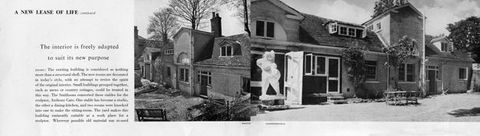
Caro also witnessed the Smithsons’ work firsthand when they converted two garage spaces (formerly stable berths) and a chauffeur’s living quarters attached to his Hampstead home into a functional living and work environment.28 This may be counted as among the couple’s first architectural commissions. One garage became Caro’s studio, while the other was transformed into a joint dining room and kitchen. The chauffeur’s two rooms were combined into a large sitting room. The transformation left a large open courtyard where Caro could also work on his sculptures. According to the artist, the Smithsons “made several changes and improvements over the years”, but the specifics of these alterations were not, to my knowledge, documented.29 This conversion was prominently featured in an article in a 1956 issue of House and Garden entitled “A New Lease on Life”, which discusses the aesthetic and practical benefits of reusing and updating older architectural structures (fig. 4). The article noted that, “whenever possible”, the Smithsons redeployed the original materials in their conversion for Caro.30 While certainly not as radical as the Hunstanton School, the Smithsons’ project for Caro—with its repurposing of existing materials—can still be productively classified as new brutalist.
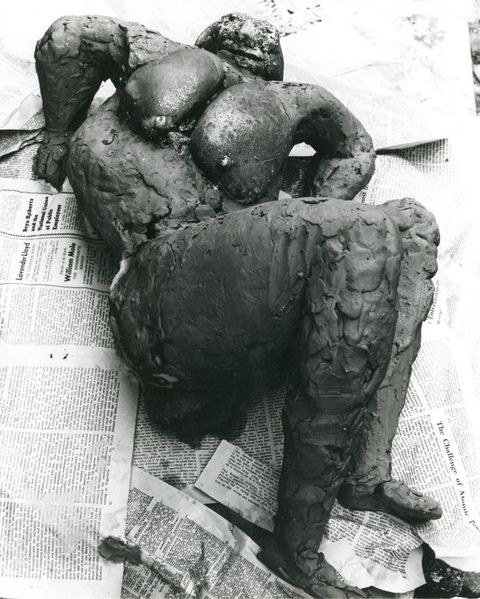
28Although he was not directly involved with the branch of the Independent Group associated with new brutalism, Caro did share visual concerns at this point with artists featured in Banham’s article. This is clear from looking at Caro alongside Magda Cordell, whose 1955 sculpture Figure (see fig. 3) could almost be mistaken for Caro’s work of this period, for example Woman Waking Up (fig. 5). Both works incorporate an expressive figuration that acknowledges continuities between the physicality and raw material of the human body and lifeless piles of clay or plaster.
Additionally, Caro applied new brutalist “as found” strategies of appropriation more directly in his own work at this time. In 1956 he incorporated objects such as pebbles into his sculptures and subsequently used these found objects as models for a series of smiling head sculptures.31 As Martina Droth suggests, he may have learned this strategy from his time assisting Henry Moore, who also collected and incorporated pebbles and other small natural objects into his work in the early 1930s.32 In the context of Caro’s exposure to new brutalist ideas, however, his appropriations of pebbles had a postwar London specificity that was also independent of Moore. Caro further embodied this ethos in 1959 when he incorporated the non-organic materials of the lid of a trash can and a car bumper into an assemblage-based work, which he later destroyed.33
31The artist’s interest in new brutalist ideas is apparent in a 1974 interview in which Caro compares his practice of sourcing rocks for these early sculptures to the work of a picture magazine editor:
34I used stones but they were more sharded and the sculptures were even more intense—in rather the way that a photograph is chosen for . . . Tempo or Life Magazine because that is the very moment that sums up, say, the man lighting up his cigarette [the subject of Caro’s sculpture from 1957]. I used to look at photographs in those magazines because they chose the photograph which gave that moment.34
Not unlike the organizers of Parallel of Life and Art, Caro thought of his own transformations of clay or plaster around 1955 at least partially through photography, comparing the medium’s contradictory qualities of both faithfully recording and defamiliarizing the world with his own practice of sculpture.35
35Caro took this attitude toward sculpture and photography even further by using Nigel Henderson of the Independent Group as the primary photographer of his work in the mid-1950s. (We have already encountered one such photograph: Henderson snapped the picture of Woman Waking Up.) In a letter to Henderson from 1957 ordering reprints of some of these photographs, Caro included small drawings that specified the desired images (fig. 6). He later recalled that Henderson was a frequent visitor to his home and studio and that the resulting photographs were particularly memorable for “getting inside” his work.36 Many of the photographs of his figurative work in Caro’s archives feature Nigel Henderson’s studio stamp on the reverse.37
36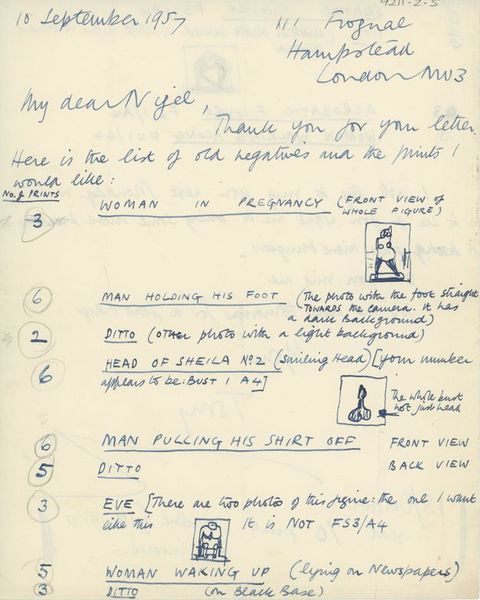
Henderson’s photographs of Caro’s sculptures from this period further emphasize this understanding of an “as found” aesthetic, presenting the work at times as akin to raw and discarded objects. For instance, in Henderson’s photograph, Caro’s Woman in Pregnancy—standing in the courtyard of the artist’s Hampstead property—becomes something gritty, urban, and raw, with the titular woman glancing down at a pile of trash and a box with paint dripped down its side (fig. 7). Henderson also photographed a clay model of what became the bronze Woman Waking Up, showing it lying on scattered sheets of newspaper, as if it has been discovered in the trash or in an abandoned, bombed-out lot (see fig. 5). The contemporary sculptor Antony Gormley expands on this idea in talking about the image in 2014: “the forms are soaking into the sheets of newspaper, looking like some meat hastily unwrapped from the butcher. The directness of the handling is vital and true”.38 Henderson’s photographs also correspond to some of the critical responses to Caro’s figurative works of the 1950s: Andrew Forge characterized Caro’s figurative works as akin to “black snowmen” of “monstrous vitality”.39 Furthermore, in a review illustrated with Henderson’s photograph of Woman Waking Up, Lawrence Alloway noted how the sculptor “dramatizes the emergence of human beings out of raw material”, with the results residing somewhere “between rocks and newspapers photographs”—a comment that seems to tie Caro’s work to the raw directness of new brutalism, including the media landscape of Parallel of Life and Art.40 At this point, Caro seemed to relish how Henderson’s photographs could reinvent his sculptures and even increase their sense of brutality and abstraction.
38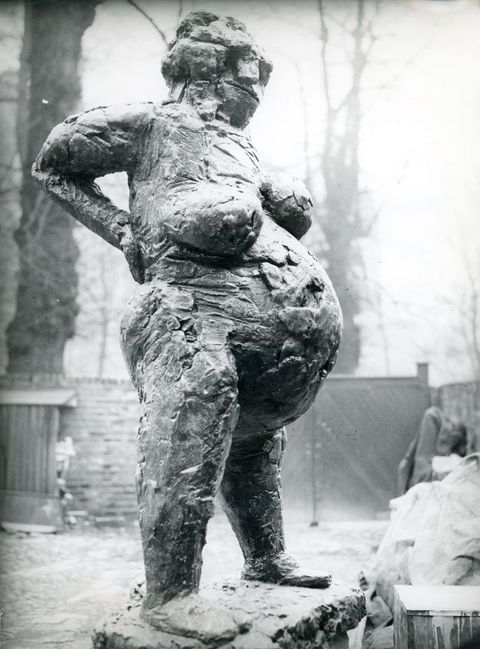
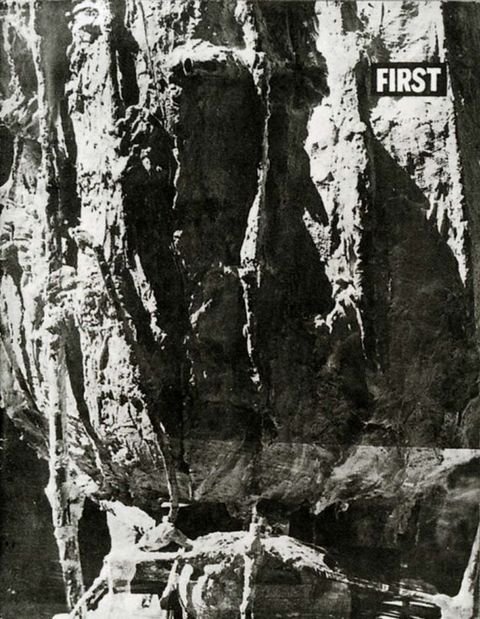
On the eve of his first trip to America in 1959, Caro’s sculpture was still being photographically transformed, although not necessarily by Henderson. The cover of the initial volume of First, the “occasional” magazine published by the Sculpture Department of Saint Martin’s School of Art, featured a detail of a Caro plaster cast from 1959, which he later revealed to me was a sculpture called Seated Woman, now destroyed (fig. 8).41 This extreme close-up of the work’s surface negates its identity as a sculpture and obscures the legibility of its ostensible subject. The sculpture begins to resemble a microscopic image, the side of a mountain, or another image that might have appeared in Parallel of Life and Art or in Banham’s article on new brutalism—crudely expressive and pictorially allusive.
41Brutalism Aestheticized: Caro’s Painted Steel Sculptures
So far, this article has attempted to situate Caro’s work of the mid- to late 1950s as participating in a dialogue—albeit from a slight distance—with the Independent Group members interested in new brutalism, especially their ideas of misreading found objects and photographs based on formally expressive properties. In 1960 Caro began producing his famous painted steel sculptures. The contemporary American artist Matthew Monahan describes Caro’s abrupt shift in practice this way: “Almost overnight he seems to have shed his skin. Kneaded clay and heavy human masses, figures turned in upon themselves swollen with humanity; all of a sudden this gives way to the bright, cold landscape of steel”.42 We can take the differences in the works farther: where the 1950s works are darkly colored, closed off to the viewer, and expressively lumpy, and convey human weight, the newer works are painted (often brightly), are open to the space around them, have a smooth surface, and seem to defy gravity. While sculptures such as The Horse and Midday soon became, in the words of critic Dave Hickey, “pre-emptive icons of high modernist art”, might they also be considered new brutalist? (fig. 9; see fig. 1).43
42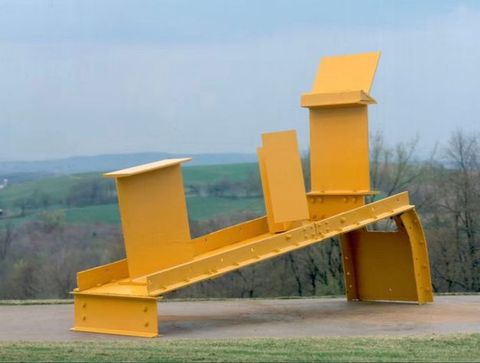
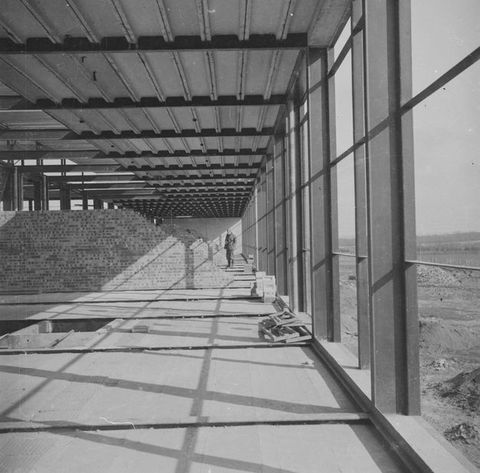
Returning to the architecture of the Smithsons can help with this question. As discussed earlier, Banham’s inclusion of a photograph of the rigid and harsh geometries of the Hunstanton School in his 1955 article on new brutalism does not seem to reflect the barely controlled chaos and rough aesthetic of his other inspirations on the magazine page. Yes, materials are not disguised in any of these images and there is a facticity about them all, but Jackson Pollock’s drip paintings and Henderson’s found sgraffito have a visual sense of anti-order that the images of the Smithsons’ architecture do not. This divergence reveals that the Smithsons and Banham understood new brutalism as an ethical commitment to honesty and truth to materials, and not merely as a visual style.44 This raises an important point in relation to Caro. If Hunstanton—with its I-beams, which simultaneously exhibit significant materiality and create a sense of openness and refinement—can be considered as new brutalist, Caro’s painted steel sculptures can also be so identified (fig. 10).
44Caro’s abandonment of lumpy bronze figures and move into abstract steel sculpture has largely been attributed to his encounters with American high modernism in 1959. A brief return to his exposure to the work of David Smith that year may begin to suggest connections between the artist’s new style and new brutalism. While Caro likely did not visit Smith’s studio at Bolton Landing until 1963, he would have noticed Smith’s use of found industrial materials in a sculpture that he remembered seeing from the Sentinel series (1956–61).45 While Caro rejected the older sculptor’s reliance on allusive figuration and totemic human presences in this series and other bodies of work, he was certainly influenced by Smith’s welding of found and disparate steel elements into a single sculpture.46
45Famously, Caro constructed his first abstract steel work Twenty-Four Hours in 1960, on his return to London after his first trip to the United States (fig. 11). The sculpture’s steel circle is related to Noland’s target paintings from this same period, especially given the rings and “bullseye” implied in Caro’s form. Additionally, Caro seems to reject his earlier works’ embrace of earthbound mass by making the heavy steel seem weightless in Twenty-Four Hours. From the front view, for instance, the circle appears to hover without support, defying gravity. Nevertheless, it retains a substantial material presence. As with a number of his other early painted steel works (such as The Horse), Caro chose a dark hue, emphasizing its raw qualities, explaining in 1974 that he “used brown or black paint and the sculptures looked more as if they were destined for a locomotive factory than an art gallery”.47 This dark tint could also reference the many Smith sculptures that feature a similar color.48 Twenty-Four Hours thus floats between an abandoned industrial form—perhaps a dulled circular saw—and a sculpture that, in Fried’s words, expressed an “achieved weightlessness”.49
47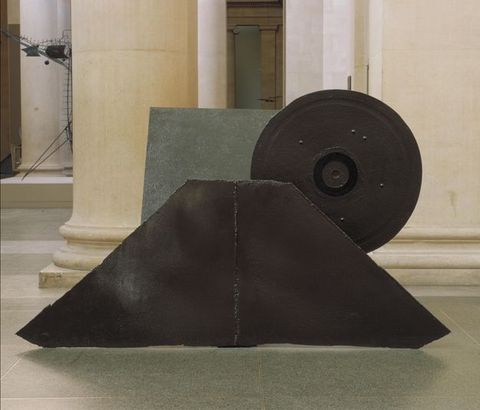
Later in 1960, Caro made Midday, which looks even more industrial (see fig. 9). Its constituent parts are clearly identifiable as steel building materials: Caro fastened three I-beam pieces on a sloped steel plane (with bolted and raised sides that make something like a half I-beam) that is itself supported by another I-beam at the lower end of the slope and a different piece of metal at the raised end. Each I-beam component on the slope is differentiated. Caro placed the piece near the top so that it occupies the width of the slope, propped it up with additional steel, and then topped it with a tilted plane that resembles a car spoiler; oriented the unadorned bottom I-beam exactly perpendicular to the top element; and placed the third piece between the other two (but closer to the top) in a way that breaks the work’s right-angled rigidity, as it seems, almost impossibly, to hover in mid-tumble down the incline. This is a work made of heavy metal that also seems to float. Fried later discussed how it was Midday that inspired his early writings on Caro, including the idea of weightlessness and its particular mode of communicative syntax (coming out of the French philosopher Maurice Merleau-Ponty), which is discussed later.50
50Caro learned much from his exposure to American artists and ideas, and his work changed significantly after his 1959 visit. Throughout the 1950s, Clement Greenberg developed his line of criticism, which reached a kind of conclusion in the radio broadcast and later publication of “Modernist Painting” in 1960–61.51 He championed paintings—such as Noland’s targets—that simultaneously proclaimed their flat materiality while also transcending that materialism through painted optical effects. In some ways, Caro took this idea and applied it to sculpture: making sculptures that emphasize the heavy weight of I-beams while also negating the very fact through elegant composition and uniform color.52
51The early 1960s was also the moment of a broader appeal for Greenberg, as his popular (and revised) collection of essays entitled Art and Culture appeared in 1961, a publication that also provoked a backlash almost immediately in the United States.53 Reviews by Hilton Kramer in Arts Magazine and Robert Goldwater in Partisan Review show cracks in Greenberg’s hold over the New York art world, with both critics noting the limitation of considering only the optical qualities of a work of art.54 The ascendency of pop and happenings in that early 1960s moment—given their engagement with popular culture and with contingent actions, respectively—also shows a resistance to Greenberg’s ideas.55 While the critic’s power in New York was beginning to wane, his influence in Caro’s London was strong for the first half of the 1960s, as demonstrated by the opening of Kasmin Gallery in 1963 with a solo exhibition of Noland’s works.56
53Michael Fried, whose criticism took Greenberg’s ideas and gave them philosophical and phenomenological heft, became Caro’s most important interlocutor in the 1960s. He wrote the catalogue essay for Caro’s 1963 breakthrough exhibition at the Whitechapel Gallery in London and continued to champion him. In 1967 he elevated Caro into one of the heroes fighting for the values and ethics of modernism against the literal geometries of minimalism in his famous polemic “Art and Objecthood”. Caro’s sculptural autonomy and implied gestures worked against what the critic saw as the literalist, anti-art tendencies of minimalist sculpture.57 For Fried, the painted steel sculptures not only transcend their constituent parts through the “achieved weightlessness”, but also attain a “presentness” that suspends time and models an allusive, not direct, mode of communication for the viewer. As he wrote in the Whitechapel introduction: “in Caro’s work gesture is evoked, and at its best liberated, through configurations made by assembling lengths of steel girder, aluminum piping, sheet steel, and sheet aluminum”.58
57While this may be the case with Midday, I want to argue that the sculpture also relies on a material honesty and transformations of readymade industrial materials—ideas that extend the artist’s debt to new brutalism. Later in the decade, the British critic John Russell noted how “nine people out of ten” would mistake a Caro sculpture in public for “something that the builders had left behind”.59 Similarly, a British reviewer of his 1963 Whitechapel show confessed that “to disguise a girder is really not possible”, while another, echoing Gertrude Stein, remarked that “a girder is a girder is a girder”.60 These are modernist works that also retain their readymade material qualities, especially in the London context of new brutalism.
59Caro’s own recollections about finding materials for these early canonical sculptures reiterate the “as found” quality of the metal: “I went down to the docks when I got back [from the United States] and found pieces of beams, big H-beams, also rough pieces that had been cut out of bridges, [and then] got a lorry and got them back here [to my studio]”.61 Another account describes him visiting industrial scrapyards in Canning Town in the East End of London for materials for his new working process.62 The delivery of these materials to his studio was very dramatic, according to the artist: “Long steel units were delivered to my house by reversing a truck fast and slowing on the brakes, this meant the steel beams would shoot off the end of the lorry with an almighty bang, shaking the houses all around, to the horror of my neighbors”.63 Not only did Caro travel to Canning Town and the London Docks to source material for his sculptures, but he remembers the sheer weight, materiality, and even noise of these metal components. He also did not want to transform these materials too much, saying in a 1961 interview, “when I’m working, I don’t like to give the elements too much personal processing”.64
61Where Greenberg and Fried focused on the optical qualities of Caro’s sculptures from the early 1960s, a number of British critics noted the industrial or engineering connotations of the artist’s materials. In 1964, for instance, Norbert Lynton wrote, “Caro’s first constructions tended to hint at industrial or agricultural machinery, especially when painted orange or brown”.65 In a review of the 1963 Whitechapel exhibition, Charles Spencer wrote in Art Review: “Girders and metal bars are usually associated with cold, unemotional situations, even brutality”. He went on to say that Caro’s “great achievement” is that he brings “moods of gaiety, drama, lyricism” out of these rough materials, comparing the results to “poetry”.66 Spencer’s words echo the Smithsons’ description of new brutalism (quoted earlier) as fashioning a “rough poetry” from the “confused and powerful forces” of mass production. While Caro would discuss the industrial components in his work, he resisted connecting these materials to broader social and economic discourses. In a contentious interview with Peter Fuller in the late 1970s, for example, he dismissed any connections the critic was trying to make between his works and industrialized labor or indeed any social or economic forces.67
65In a later critical essay, Fuller also connected Caro’s work to the darker, more commercial aspects of capitalism: “Caro’s work was nothing if not of its time: it reflected the superficial, synthetic, urban commercial, American values which dominated the 1960s”.68 Despite the criticism, Fuller’s account is a rare socially engaged reading of Caro’s painted steel sculptures. The political accounts that do exist are almost exclusively from British writers.69 While Caro’s work is still commonly seen in American museums, commentators there had begun to turn away from it (as noted earlier) by the mid-1960s (as well as from most high modernist artists championed by Greenberg and Fried), gravitating instead toward the movements they dismissed, especially pop and minimalism. The last gasp of Caro’s centrality in America was his 1975 exhibition at the Museum of Modern Art (MoMA)—in the midst of a New York boom in performance and conceptual practices—which privileged a modernist Caro and failed to display a single one of his works from the 1950s.70 As Alex Potts and others have argued, Caro’s work became and has remained, at least in the United States, “a kind of exemplar of Greenbergian high modernism”.71 This article is attempting to bring out the ways that a Caro sculpture can espouse American high modernist values while also suggesting the sociopolitical and anti-modernist contingencies associated with new brutalism.
68In Britain, however, critics recognized this duality of Caro’s practice. For example, Lynton captured what he labeled as the sculptor’s “lyrical brutalism” in his review of Caro’s 1963 exhibition at the Whitechapel Gallery:
72I have already referred to the lyrical brutalism of his work as a constant. . . . This lyricism through violence appeared in the wooly monsters of his figurative period, at once fearsome and domestic, and it appears in the current tableaux [painted steel works] in which the toughness of metal and of bolts and nuts, their weight and associations these materials bring with them, are flippantly countered by the playful gestures and fanciful placing of the component pieces and false innocence of coats disguising colour freshly painted on to them.72
For Lynton, Caro’s bolts and heavy metal play off the playful gestures of his composition. I am intrigued by his reference to the “false innocence” of Caro’s painted steel works and would like to take the charge of dishonesty even further. In John Grindrod’s popular history of the architecture of London’s postwar reconstruction, he questions the material honesty of the Smithsons’ Hunstanton School: “After all, its much-vaunted authenticity was a species of artifice, with schools, offices, or houses, ‘dressed up’ as factories, power stations or machines”.73 Caro’s early painted sculptures must be seen as the reverse, as brutal materials of heavy industry and building construction “dressed up”—through arrangement and color—as high modernist sculptures.
73Works like Midday, building on Lynton’s insight, are thus hybrids between American high modernism and the new brutalism associated with the Smithsons and Banham. Before his introduction to Greenberg and Noland, Caro worked to convey the raw power of rugged materials, through sculptures that appear like found objects, with the weight, gravity, and drama of the human body. After his trip to the United States, he was still transforming found objects but he was now transforming them into sculptures that also correspond with the tenets and ideals of American high modernism. Put another way, the process and materials are consistent with Banham’s theories, but the results are high modernist works of art that push against the anti-art tendencies of new brutalism. They are “as found” objects that also transcend their unruly qualities. Thus, Midday is not a clean break with Caro’s works of the 1950s but an attempt to reconfigure them via Greenberg and Fried into a distinctly transatlantic hybridity. The earlier works are vital to a more complete and honest understanding of Midday and other works from this period.
This duality between new brutalist and modernist ideas is also clear in Caro’s most famous sculpture, Early One Morning. This work eschews the gloppy paint and bulky industrial aspects of his earlier steel works, such as Midday, in favor of a smoother and more refined statement. As Rosalind Krauss’s classic interpretation in Passages in Modern Sculpture suggests, viewers get two mutually exclusive views of the work, depending on their perspective. From the side, we see a lateral object that we can look down on, one that exists in our physical space (fig. 12). From the front, we see the opposite: an image that discourages us from looking down, a vertical assembly that denies its own physicality (fig. 13).74 Here Caro is hedging his bets, perhaps implying his hybridity through the popular photographic reproductions of his work. Viewers see both a strange and heavy object made from urban scraps and an object that denies all evidence to the contrary, floating above the mundane frays of everyday life.
74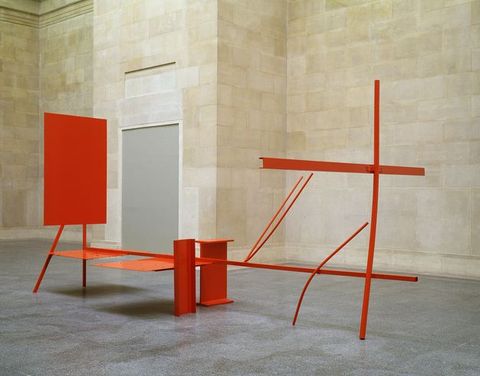
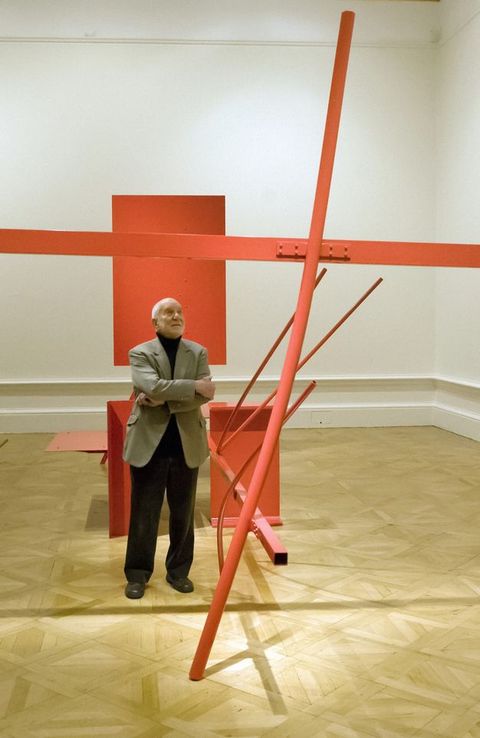
Caro, New Brutalism, and Sociability
Despite their different critical frameworks, Fried’s modernist vocabulary and new brutalist architectural theory share surprising common ground, particularly in their treatment of materials and sociability. A look at the Smithsons’ entry for the Golden Lane Housing competition from 1952—one of the most famous new brutalist artifacts—is instructive in this regard. The competition was held to redevelop a site in east central London that had been left empty after bomb destruction. The Smithsons wanted to use industrial materials to fashion a new kind of housing for a new kind of city, in an attempt to bring a heightened sociability to a high-rise tower block usually associated with urban isolation. As Ben Highmore has demonstrated, the architects were inspired by Nigel Henderson’s photographs of children playing together in the streets of Bethnal Green, east London.75 These photos inspired them to think about an ethics of social architecture—to design buildings where communities could thrive despite the increasing commercialization and homogenization of urban space. This was architecture to promote social interaction and a sense of play among the building’s residents.
75To illustrate these ideas, their architectural entry included a deep perspectival drawing with collaged photographs cut from magazines, here including Marilyn Monroe and Joe DiMaggio (fig. 14). Other views included the French actor Gérard Philipe, the Indian nationalist and first Prime Minister Jawaharlal Nehru, and art students such as Terence Conran. The decks of these buildings, what they called “streets in the air”, were to the architects a modern-day counterpart to the traditional street.76 Highmore views this representation as utopian: “The street decks don’t simply sustain the sociability of the streets of Bethnal Green[;] they transform it into a utopian setting where the daily grind of working class life is miraculously swapped for glamor, youth, and health”. And in a phrase that could also describe Caro’s painted steel works, Highmore characterizes the image as “one of lightness and easy sociability”.77
76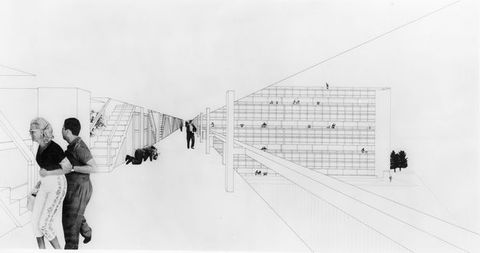
Like the Smithsons, Michael Fried was also interested in ideas of sociability, albeit sociability of a more abstract type, which he viewed as vital to Caro’s sculptures. Much as the Smithsons found inspiration in Henderson’s pictures of children playing in an urban street, Fried referenced a child to describe the effects of Caro’s painted steel work in his 1963 introductory essay for his Whitechapel exhibition, which introduced such works to the public for the first time: “I want to suggest that our situation, or predicament, in the face of the present exhibition is roughly analogous to that of a small child, at most on the verge of speech, in the company of adults conversing among themselves”.78 (It is instructive that both Fried and David Sylvester, cited at the start of this article, discussed Caro’s sculpture from the point of view of a child.) Fried expanded on the ideas of an abstract, utopian mode of social communication at the end of his essay:
7879In Caro’s more successful sculptures one discovers the allusive syntax of our own purest and more passionate gestures used to construct gestures even more pure and passionate—and armed, beside, with what one hopes it still makes sense to speak of in our time as the durability of art.79
For Fried, Caro’s work is distilled gesture, showing viewers a mode of transcending the usual limits of human communication. Like the Smithsons’ Golden Lane entry, Fried’s interpretation of Caro is interested in giving form to sociability in the light of an increasingly alienated consumer society. One version is modernist and sculptural, the other architectural, in real built space.80 Later in the 1960s, Fried even talked about how Caro’s work “shares with architecture a preoccupation with the fact, or the implications of that fact, that humans have bodies and live in a physical world”.81
80Fried’s understanding of Caro’s painted steel sculptures becomes more embedded in a transatlantic dialogue when we consider how the critic’s own formative transatlantic experiences in the early 1960s shaped his critical voice. After completing his Rhodes Scholarship at Oxford in 1961, Fried remained in London and secured a position writing criticism for Arts Magazine at the age of twenty-two. (Greenberg’s letter introducing Fried to the editor Hilton Kramer was instrumental in landing him the job.82) Fried’s monthly “Letter from London” column, running from December 1961 through October 1962, represents his earliest published art criticism.83 He immersed himself in the London art world, seeing many exhibitions and choosing which ones to write about. Even as a new critic, he had the confidence to pen scathing reviews of established British artists such as the sculptor Lynn Chadwick and the “kitchen sink” realist John Bratby.84 While Fried chose not to include these London features in collecting his critical writings about contemporary art into a book, they nevertheless suggest how the city shaped his view of Caro, as well as his broader view of modernism.
82I want to focus briefly on two aspects of Fried’s early London criticism that are relevant to his understanding of Caro’s painted steel sculptures. First, Fried seemed fixated on John Berger, the Marxist critic and public intellectual who measured artistic success in terms of the artwork’s engagement with class struggle. This critical environment would have represented a striking departure for Fried, given how the conservative political climate of the Cold War had largely foreclosed such Marxist perspectives in late 1950s America. Berger championed realist artists such as Bratby and the Italian social realist Renato Guttuso.85 In Arts Magazine, Fried reviewed Berger’s collected criticism—entitled Permanent Red—while also going out of his way to dismiss the critic in other reviews.86
85The politically charged context of London perhaps forced Fried to contend with or compete against Berger’s Marxist model of art criticism. In his review of Permanent Red, Fried made a surprising admission of the artwork’s ties to politics: “Whether we like it or not, after Marx it is no longer possible for anyone to delude himself that his attitude toward art or society are a-political”.87 Following this, Blake Stimson has noted that both critics share a common starting point: “modern art’s loss of any meaningful connection with a popular audience”.88 Berger and Fried responded to this challenge, however, in vastly different ways: Berger by championing artworks that mass audiences can understand, and Fried by striving to find advanced works that can create utopian moments to counter the drudgery of modern existence. Berger’s staunch Marxism, which Fried could not have experienced in New York, may have helped push the young American critic into his trenchant critical position.
87Fried also published positive notes about three British abstract painters: Bernard Cohen, Richard Smith, and especially Robyn Denny. In his glowing review of Denny’s show at the Molton Gallery, Fried quoted Lawrence Alloway at some length about the way Denny’s paintings—for example, Wardrop I—look like thresholds and “imply an ambience of human use” (fig. 15).89 He then discussed how Denny’s canvases both suggest and negate illusionistic space, leading to his conclusion on the painter, which sounds like a warm-up for his later thoughts on Caro about gesture: “There is nothing like a painterly gesture in any of the paintings, only the possibility of significant gesture, of action, for us”.90 It is only fitting that Fried first met Caro at the dinner after Denny’s gallery opening.91
89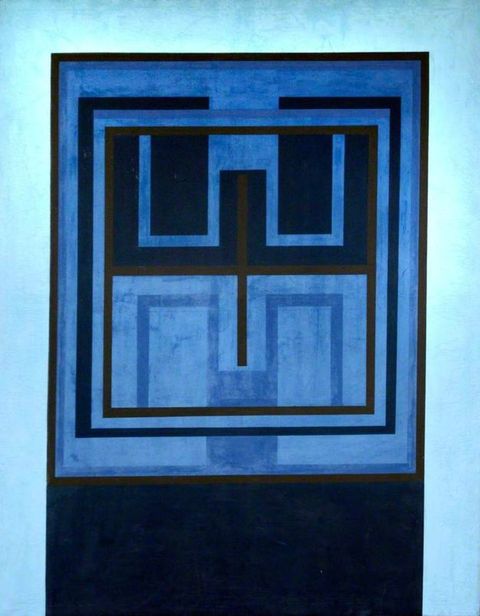
While Fried compared Robyn Denny’s canvases to American examples, the painter arrived at his abstraction after pop-like paintings such as Austin Reed Mural from 1960, which featured, as David Mellor puts it, “metropolitan iconography”—a cubist-inspired jumble of words and fragments of words that approximate an overwhelming city landscape of commercial and traffic signs.92 Denny described his work in terms of “urban people who are contained by an urban environment and conditioned by it”.93 By the time of his 1962 exhibition, however, these urban references had merged with a painted formalist language not unlike American high modernism. What emerges in Fried’s reading of a painting like Wardrop I is a pattern of selective vision: the critic recognized the aesthetic power of artists like Denny and Caro while remaining blind to their debt to new brutalist ideas about material honesty and urban experience. In a way, these oversights suggest that Fried’s high modernist criticism depended on suppressing the very London-based theories that had helped generate the art he championed.
92Caro, New Brutalism, and Reconstruction Britain
Another Nigel Henderson photograph is compelling for what else it might suggest about the visual landscapes Caro’s painted constructions inhabited: London perpetually under construction after the destruction of World War II (fig. 16). Nazi bombs changed the nature of Greater London, damaging or destroying over one million houses and flats, as well as the majority of London’s industrial and shipping infrastructure.94 Images of the postwar city riddled with bomb damage and construction sites have been described by period experts as “so strange . . . that they scarcely translate into the terms of the everyday world”.95 As a resident of Hampstead—which includes the highest point in London, Parliament Hill—Caro would have likely witnessed the city’s constantly changing skyline from a distance, including the strong horizontals and verticals of steel cranes and steel girders. The rebuilding of London was a frequent subject of two of the city’s most important expressionist painters, Frank Auerbach and Leon Kossoff. Caro was friends with the former, as they taught together at Saint Martin’s School of Art. According to Ian Barker, the pair had long discussions about art in a Soho cafe in the evenings after class, when the painter was initially turning to building sites as a subject.96 Auerbach found a way to capture the messy, muddy reality of building construction in his paintings—the in-process chaos before the finished rationality of a geometric building. He was especially drawn to steel girders as an organizing principle.97 He constructed his painting Maples Demolition, Euston Road—a picture showing the destruction that was a prerequisite to reconstruction—with a cubist geometry of I-beam girders (fig. 17).
94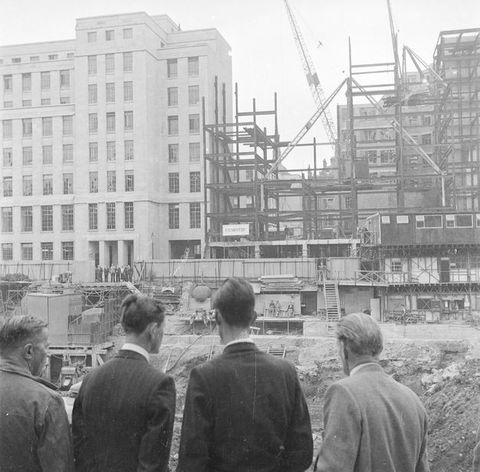
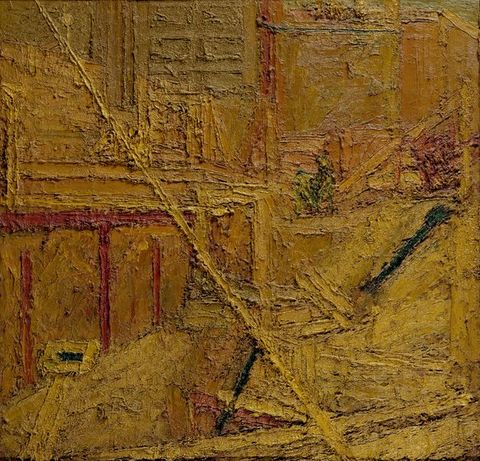
For London viewers encountering Caro’s painted steel works like Midday, the steel would have unavoidable associations with the city’s rebuilding. Whether or not Caro intended these connections to the broader culture of London in the 1950s and 1960s, the works nevertheless carry material traces of the city’s reconstruction. While Auerbach made active building sites the subject of his paintings, Caro’s work adopts a more abstract ethos of architectural renewal: organizing and constructing raw and industrial materials into the refined form and language of fine art.
As I mentioned above, Fried described the “achieved weightlessness” of a sculpture like Midday—how what should be a weighty aspect of the work appears to defy gravity, like the tilted I-beams floating on the slope. For him, weightlessness was an analogue to a euphoria of transcending traditional limits, which could also suggest a metaphor for a subjectivity liberated from the constraints of everyday life.98 Likewise, certain modernist tower blocks from this reconstruction era also used a similar language of weightlessness, especially as portrayed in the fashion and architectural press. John Cowan’s fashion photography, particularly a few images featuring Jill Kennington in front of the brutalist concrete Sparkford House in Battersea in 1966, captures this sense of possibility and transcendence in London’s modernist architecture that Fried also intuits in Caro’s sculptures (fig. 18). The photographer himself rejected traditional limits for his chosen medium. Kennington herself later recalled his process: “shooting on the floor downwards, completely fluid, unhindered by tripods, etc.”.99 This break with tradition might also recall Caro’s rejection of the pedestal. Kennington’s own gestures of euphoria—especially her arm, which breaks free from the tower’s linear brutalism of steel and concrete—almost recall the expressiveness of a painted steel sculpture by Caro. The photograph’s rejection of a ground, combined with Kennington’s spirited leap, also adds to the image’s own “achieved weightlessness”. This is all to say that Caro, reconstruction architecture, and London’s optimistic attitudes in the 1960s all owe something to the “rough poetry” of the new brutalism of the previous decade, the way reconstruction in a city with a long history, like London, relies on the raw materiality of destruction. As Lionel Esher wrote in a history of the postwar rebuilding of England, “building and rebuilding has always been a pretty brutal business, since new construction is only possible on the ruin of something else”.100
98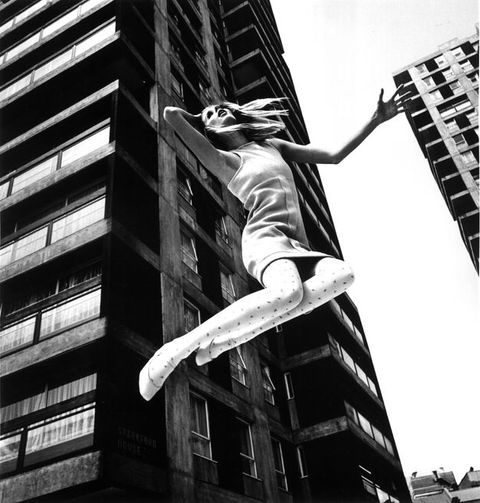
This new brutalist understanding of Caro—especially a connection to the changing built environment of postwar London—was already evident in the artist’s 1963 Whitechapel Gallery exhibition. While Caro’s sculptures have typically and more recently been displayed in autonomous isolation from one another (as in Tate Britain’s 2005 installation), the Whitechapel presentation was altogether different, with the main hall showing at least six works including the monumental Early One Morning and Pompadour (1963) (fig. 19). In his preface to the catalogue, Bryan Robertson noted how the “floor of the Whitechapel Gallery is on the same level as the street outside”.101 One unsigned review began by suggesting that Caro’s sculptures made it look like the London County Council was “spending a lot of money sprucing up the Whitechapel Art Gallery”, and continued: “Lorry loads of gaily coloured steel sheets, metal tubes and massive girders unloaded there during the past few days had nothing to do with rebuilding plans”.102 The cracked concrete floor and the presence of a vent that could also pass as a sewer drain only added to the urban feeling of the Whitechapel display. Combined with the chaotic presentation of Caro’s painted steel sculptures—many of which were composed of building materials such as I-beams—the exhibition space became an abstract approximation of the bustling city in the process of reconstruction.
101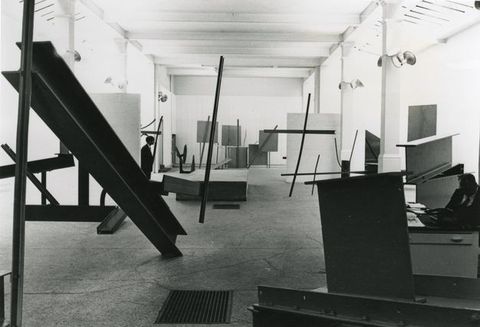
The area around the Whitechapel was bombed extensively during World War II, and visitors would have seen active construction sites in the immediate vicinity of the gallery’s front door when entering and leaving the space. Just across Whitechapel High Street, for instance, the site for a new flatted factory (a building that houses numerous small manufacturing firms) to be known as Central House was being cleared for construction to start the following year, and about two blocks away another modernist flatted factory was in the process of being constructed at 1–13 Adler Street.103 Taking this logic further, this exhibition space can be viewed as an abstract, utopian rendition of a new city—an environment that is playful and intuitive—with steel used to construct a model of human expressiveness and not just functional efficiency. As the critic Adrian Searle notes in his review of Caro’s 2005 Tate Britain exhibition, Caro’s work “looks great when one sees other people in relation to it, embroiled in the forms, silhouetted and juxtaposed with it”.104 Like the Smithsons’ plans for Golden Lane, the sculptures enabled a sense of sociability.
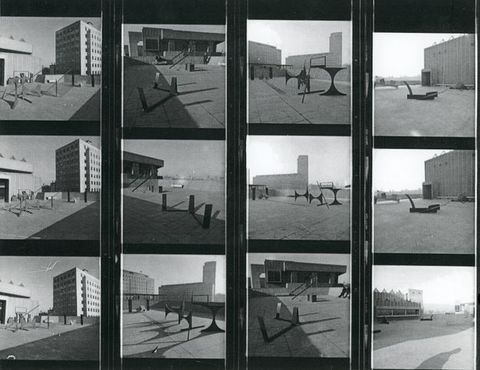
103Caro’s connection to London’s urban fabric was further solidified at the end of the decade, during a 1969 retrospective at the Hayward Gallery—a massive concrete brutalist structure finished in 1968 and designed by the lead architect Norman Engleback. Curators placed some of Caro’s painted steel works, including Month of May and Midday, on the roof of the gallery, with a view of the Thames and the city skyline (figs. 20 and 21; see fig. 9). In the surviving photos, the sculptures convey the “active construction site” of the Whitechapel installation but—through the magic of foreshortening—are now in a lively conversation, perhaps even dancing, with the distant London buildings, many of which were built in the previous twenty years. Caro’s brutal and high modernist steel on the Hayward roof can be seen as an apt metaphor for the transformation of London’s urban fabric in the 1960s: both have converted steel into something with a backbeat that can swing.105
105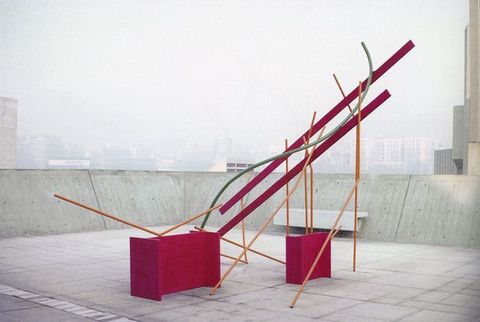
This hybrid understanding of Caro’s practice—a new brutalist mode of American high modernism—helps explain his profound influence on the next generation of British sculptors. Through his innovative teaching at Saint Martin’s School of Art from 1953 onward, Caro became the so-called father of British “new generation” sculptors such as Phillip King, William Tucker, and Tim Scott, and of later figures such as Barry Flanagan, whose anti-form pieces composed of materialist presentations of rope, sand, and other unconventional materials directly challenged the aesthetic autonomy championed by Greenberg and Fried.106 In 1967 a group of Caro’s students even began using a disused brewery in southeast London, Stockwell Depot, for studios and exhibition space. The participating artists, including Peter Hide who sometimes made painted steel works that resembled Caro’s, emphasized the relation between their modernist abstraction and the raw, formerly industrial environment of their exhibition.107 Caro’s pedagogy, like his sculptures, operated as a transatlantic hybrid, capable of inspiring both modernist refinement and anti-modernist experimentation.
106Caro’s sculptures of the 1950s and 1960s have always been rooted in their London origins, but this story was often overlooked once his sculptures were linked to the high modernism of Greenberg and Fried. The new brutalist undercurrent in his work—especially its engagement with industrial materials, urban reconstruction, and social contingency—reveals these 1960s sculptures as complex mediations between traditions often viewed as disparate. Rather than expressing only high modernist transcendence or their status as mere industrial works embracing the qualities of new brutalism, works like Midday derive their power from their ability to hold both possibilities in productive tension. They are, to return to the metaphor suggested by The Horse at the start, Trojan horses that smuggle the material and social concerns of postwar London reconstruction into the rarefied discourse of American high modernism. Recognizing this hybridity not only enriches our understanding of Caro’s achievement but also suggests new ways of reading the transatlantic dialogue that shaped postwar art on both sides of the Atlantic.
Acknowledgements
I have presented versions of this material at four conferences: “The New British Sculpture—Reviewing the Persistence of an Idea, c.1850–Present” at the Henry Moore Institute in 2011; “Anthony Caro: New Approaches” at the Yale Center for British Art in 2012; “British Abstraction After World War II” at a College Art Association meeting in 2018; and “Shaping the Future that Was” at the Henry Moore Studio and Gardens in 2023. I would like to thank the organizers and participants of all these events, where I had especially fruitful discussions with Martina Droth, Alex Potts, Sarah Rich, Rob Slifkin, Alex Taylor, Jonathan Vernon, and Jon Wood. Thanks also to the Anthony Caro Centre for opening their archives and to the centre’s Ben Caro for remote research help. Finally, I would like to thank the editors of British Art Studies and the anonymous readers for their comments, as well as Wake Forest colleagues Lisa Frye Ashe and Morna O’Neill.
About the author
-
 John J. Curley is Professor of Modern and Contemporary Art History and Chair in the Department of Art at Wake Forest University in Winston-Salem, NC. He has published widely on postwar American and European art, including recent articles on Morris Louis in Art History and on Spanish pop practices in the long 1960s in Art in Translation. He is also the author of two books, A Conspiracy of Images: Andy Warhol, Gerhard Richter, and the Art of the Cold War (Yale University Press, 2013) and Global Art and the Cold War (Laurence King, 2019). He is currently at work on a book project provisionally titled “Critical Distance: Black American Artists in Europe, 1958–1968”, for which he received fellowships from the Terra Foundation and the Paul Mellon Centre.
Footnotes
-
1
David Sylvester, “Bits of the Cat”, in Anthony Caro: Recent Sculpture (Knoedler Gallery and Waddington Gallery, 1986), exhibition catalogue, 4, quoted in Paul Moorhouse, “‘The Forms of Things Unknown’: Anthony Caro’s Sculpture”, in Anthony Caro, ed. Paul Moorhouse (Tate Publishing, 2005), exhibition catalogue, 13. ↩︎
-
2
Other British critics also compared Caro’s sculpture to playground features in the early 1960s. For example, see Robert Wraight, “On Galleries: The Girder Man”, Tatler, 9 October 1963. Wraight calls Caro’s 1963 show at London’s Whitechapel Gallery “a modern children’s paradise”. ↩︎
-
3
For discussions of Alloway’s interest in Greenberg’s theories in the context of his career championing a broad range of works associated with pop art, see Stephen Moonie, Art Criticism and Modernism in the United States (Routledge, 2022), 154; and Courtney Martin, “Introduction”, in Lawrence Alloway: Critic and Curator, ed. Lucy Bradnock et al. (Getty Research Institute, 2015), 3. ↩︎
-
4
Caro quote from Peter Fuller, “An Interview with Anthony Caro”, Art Monthly 23 (February 1979): 8. The parameters of Caro’s story are detailed in several sources, including Moorhouse, “‘The Forms of Things Unknown’”, 14. ↩︎
-
5
John A. Walker, Cultural Offensive: America’s Impact on British Art Since 1945 (Pluto Press, 1998), 82–83. ↩︎
-
6
For mention of Caro seeing Smith’s sculptures, see Elinor L. Woron, “Chronology”, in Anthony Caro, ed. William Rubin (Museum of Modern Art, 1975), exhibition catalogue, 181; and Walker, Cultural Offensive, 84. Details of the dinner party are discussed in Moorhouse, “‘The Forms of Things Unknown’”, 14. Sources from the David Smith side of scholarship suggest that Caro visited Smith’s studio in Bolton Landing during this first visit to the United States in 1959. See, for example, Tracee Ng, “Chronology”, in David Smith Sculpture: A Catalogue Raisonné, 1932–65, vol. 1, edited by Christopher Lyon (Yale University Press, 2021), 152. I have not seen definitive proof for either account. ↩︎
-
7
Alex Potts sums up Caro’s achievement succinctly: “His open, radically abstract, pedestal-less metal structures were seen to establish a new syntax for modernist sculpture freed from the vestiges of figuration and monumentality that still clung to much of so-called modern sculpture in the post-war period”. Potts, The Sculptural Imagination: Figurative, Modernist, Minimalist (Yale University Press, 2000), 182. ↩︎
-
8
See Clement Greenberg, “Contemporary Sculpture: Anthony Caro” (1965), in Modernism with a Vengeance, 1957–1969, ed. John O’Brian, vol. 4 of Clement Greenberg: The Collected Essays and Criticism (University of Chicago Press, 1993), 205–8; and Michael Fried, “Anthony Caro” (1963), in Art and Objecthood: Essays and Reviews (University of Chicago Press, 1998), 269–76. ↩︎
-
9
Barbara Rose, “Remembering 1967”, in 1967: At the Crossroads (Institute of Contemporary Art, University of Pennsylvania, 1987), exhibition catalogue, 34. This quote and a lively discussion of debates surrounding “high modernism” can be found in Gail Day and Chris Riding, “The Critical Terrain of ‘High Modernism’”, in Varieties of Modernism, ed. Paul Wood (Yale University Press, 2004), 189. ↩︎
-
10
As Day and Riding put it: “High modernism is associated with certain American east-coast artists from the late 1950s and 1960s; the painting of Helen Frankenthaler, Morris Louis, Jules Olitski, Frank Stella, Larry Poons and the sculptures of Anne Truitt. The work of the English sculptor Anthony Caro is also incorporated, along with the so-called New Generation of sculptors, most of whom, with Caro, taught or studied at St. Martin’s School of Art, London, in the same period”. “The Critical Terrain of ‘High Modernism’”, 189. Among the first instances I found for use of the term “high modernism” in Artforum was by Thomas Crow in his 1992 reflective discussion of an Annette Michelson essay on Robert Morris from 1969. For Crow, this essay attacked “the high modernism championed and articulated by Michael Fried”. Crow, “Critical Reflection”, Artforum 30, no. 9 (May 1992): 105. Fried himself had begun to use the term by 1998: see “An Introduction to My Art Criticism”, in Art and Objecthood, 15. ↩︎
-
11
I recently reframed Morris Louis’s paintings away from a high modernist discourse, showing how they also engage issues of chaos and entropy. John J. Curley, “‘Banner of an Atomic Regiment’: Morris Louis, Greenberg’s Modernism, and Science, c.1962”, Art History 44, no. 1 (February 2021): 130–62. ↩︎
-
12
Viewers can see the stamp of the steel manufacturer under the paint: “Lanarkshire Steel Co., Scotland”. ↩︎
-
13
William Tucker, in David Annesley et al., “Anthony Caro’s Work: A Symposium by Four Sculptors”, Studio International 177, no. 907 (January 1969): 15. ↩︎
-
14
Lawrence Alloway describes how critics have removed Caro from his historical context, preventing a more nuanced approach to his work. Alloway, “Caro’s Art—Tucker’s Choice”, Artforum 14, no. 2 (October 1975): 65–71. David Mellor places Caro’s work in a network of ideas about the liberated body in the 1960s, seeing Fried’s criticism as part of this same network. Mellor, The Sixties Art Scene in London (Phaidon, 1993), esp. 94–98. Alex Potts overturns a purely modernist understanding of Caro and sees the painted steel sculptures as both abstract and vaguely figurative, as modernist and anti-modernist. Potts, “Caro in the 1960s and the Persistent Object of Sculpture”, Sculpture Journal 21, no. 2 (2012): 51–62. In terms of biography, see Ian Barker, Anthony Caro: Quest for the New Sculpture (Lund Humphries, 2004). Catalogues from MoMA’s (1975) and Tate Britain’s (2005) retrospectives keep to insular accounts of formal development. Rubin, Anthony Caro; Moorhouse, Anthony Caro. ↩︎
-
15
Bryant, “Caro and the Critics: Expanding the Vocabulary of Sculpture”, in Bryant et al., Caro: Close Up (Yale University Press, 2012), 29. ↩︎
-
16
Barker, Anthony Caro, 55. ↩︎
-
17
For an overview of the Independent Group, see David Robbins, ed., The Independent Group: Postwar Britain and the Aesthetic of Plenty (MIT Press, 1990). ↩︎
-
18
Barker, Anthony Caro, 62. In addition to the Smithsons, Paolozzi, and Henderson, Ronald Jenkins assisted with the installation of this exhibition. For the importance of this exhibition and a discussion of the new brutalist image more generally, see Claire Zimmerman and Victoria Walsh, “New Brutalist Image 1949–55: ‘Atlas to a New World’ or, ‘Trying to Look at Things Today’”, in British Art Studies 4 (November 2016), DOI: 10.17658/issn.2058–5462/issue-04/vwalsh-czimmerman. ↩︎
-
19
Reyner Banham, “Parallel of Life and Art” (review), Architectural Review, October 1953, reprinted in Robbins, The Independent Group, 171. ↩︎
-
20
The exhibition also included a photographic reproduction of one of Jean Dubuffet’s Corps de Dame paintings and an image of Jackson Pollock at work in his studio, suggesting a continuity between photographs of art and other decidedly non-art pictures. For a longer account of Parallel of Life and Art, see my A Conspiracy of Images: Andy Warhol, Gerhard Richter, and the Art of the Cold War (Yale University Press, 2013), 21–51. ↩︎
-
21
Reyner Banham, “The New Brutalism”, Architectural Review, December 1955, 358. Zimmerman and Walsh note that the image of Hunstanton was “visually anomalous to the more materially messy, a-formal, and visceral illustrations of other work cited by Banham”. Zimmerman and Walsh, “New Brutalist Image”. ↩︎
-
22
For a good overview of the Smithsons’ career and their relationship to new brutalism, see Helena Webster, “Modernism Without Rhetoric”, in Modernism Without Rhetoric: Essays on the Work of Alison and Peter Smithson, ed. Helena Webster (Academy Editions, 1997), 10–123. ↩︎
-
23
Highmore, The Art of Brutalism: Rescuing Hope from Catastrophe in 1950s Britain (Yale University Press, 2013), 20. Kevin Lotery has also discussed how new brutalism depended on a combination of “high seriousness” and a “decidedly ‘childish’, unschooled logic”. Lotery, The Long Front of Culture: The Independent Group and Exhibition Design (MIT Press, 2020), 96. ↩︎
-
24
Alison Smithson and Peter Smithson, “Thoughts in Progress: The New Brutalism”, Architectural Design, April 1957, 113, quoted in Highmore, The Art of Brutalism, 13. ↩︎
-
25
Lotery, The Long Front of Culture, 96, 103. ↩︎
-
26
Banham, “The New Brutalism”, 357, also quoted in Highmore, The Art of Brutalism, 10 (emphasis original). ↩︎
-
27
Banham, “The New Brutalism”, 361. ↩︎
-
28
Barker, Anthony Caro, 55. ↩︎
-
29
Information about conversion from Anthony Caro, email exchange with author, 26 July 2013; and “A New Lease on Life”, House and Garden, November 1956, 72. ↩︎
-
30
“A New Lease on Life”, 72. ↩︎
-
31
Barker, Anthony Caro, 73. ↩︎
-
32
See Martina Droth, “Caro and the Materials of Sculpture”, in Bryant et al., Caro: Close Up, 39. For more on Moore’s practice of using pebbles and stones as models, see Sebastiano Barassi and James Copper, “Henry Moore and Stone: Methods and Materials”, in Henry Moore: Sculptural Process and Public Identity (Tate Research Publication, 2015), https://www.tate.org.uk/art/research-publications/henry-moore/sebastiano-barassi-and-james-copper-henry-moore-and-stone-methods-and-materials-r1151462. ↩︎
-
33
Barker, Anthony Caro, 83. ↩︎
-
34
Noel Chanan, “Anthony Caro: Interview for Granada Record”, unpublished transcript, September 1974, Anthony Caro Archives, London, quoted in Barker, Anthony Caro, 74–75. ↩︎
-
35
Zimmerman and Walsh, in “New Brutalist Image”, discuss how the new brutalists viewed photography as neither index nor fetish, but as something that “communicates through visual cross-relationships produced by physical juxtaposition and visual layering”. ↩︎
-
36
Caro, email exchange with author. ↩︎
-
37
The reverse of some other photographs features the studio stamp of Kim Lim, a sculptor who married another Independent Group member, William Turnbull, in 1960. ↩︎
-
38
Antony Gormley, untitled essay, in Anthony Caro, ed. Amanda Renshaw (Phaidon, 2014), 23. ↩︎
-
39
Andrew Forge, “Round the Galleries”, Listener, 17 January 1957, 102, quoted in Bryant, “Caro and the Critics”, 11. ↩︎
-
40
Lawrence Alloway, “Art News from London”, Art News 56, no. 1 (March 1957): 21. ↩︎
-
41
First: An Occasional Magazine 1 (1960): 21; Caro, email exchange with author. ↩︎
-
42
Matthew Monahan, untitled essay in Renshaw, Anthony Caro, 41. ↩︎
-
43
Hickey, “Anthony Caro: The Economies of Surprise”, in Moorhouse, Anthony Caro, 128. ↩︎
-
44
Smithson and Smithson, “Thoughts in Progress”, 113, quoted in Nigel Whiteley, Reyner Banham: Historian of the Immediate Future (MIT Press, 2002), 127. ↩︎
-
45
Woron, “Chronology”, 181. ↩︎
-
46
For accounts of Smith’s practice see Rosalind Krauss, Passages in Modern Sculpture (MIT Press, 1977), 147–71; and Joan Pachner, David Smith (Phaidon, 2013). ↩︎
-
47
Phyllis Tuchman, “An Interview with Anthony Caro”, Artforum 10, no. 10 (Summer 1972): 58, quoted in Richard Whelan, Anthony Caro (Penguin, 1974), 123. Whelan has suggested that the brownish color is “analogous . . . to Paolozzi’s use of bronze casting in the 1950s to give an ironic respectability to the use of unconventional materials”. Whelan, Anthony Caro, 31. ↩︎
-
48
See Pachner, David Smith, 64. The example of the Sentinel series that Caro is reported to have seen in 1959 also had a coat of dark paint. For the works in this series, see “The Sculpture Series of David Smith”, in Lyon, David Smith Sculpture, 198–99. ↩︎
-
49
Fried, “Anthony Caro”, 274. Alex Potts sees Twenty-Four Hours as resembling (but never becoming) a crouched sentinel with a shield. Might this be a reference to David Smith’s Sentinel, which Caro saw in 1959? ↩︎
-
50
Michael Fried, “Anthony Caro’s Midday”, Artforum 32, no. 1 (September 1993): 139. ↩︎
-
51
Greenberg, “Modernist Painting” (1961), in Modernism with a Vengeance, 85–94. ↩︎
-
52
Greenberg later commented on this quality in his short essay on Caro from 1965: “Part of Caro’s originality of style consists in denying weight by lowering as well as by raising the things in his sculpture that signify it”. Greenberg, “Contemporary Sculpture”, 208. ↩︎
-
53
Art and Culture was not published in the United Kingdom until 1973, although imported copies circulated widely in art schools before this date. John Walker discussed how the book was “much read” by Saint Martin’s students in the 1960s. Walker, Cultural Offensive, 216; see also Clement Greenberg, Art and Culture (Thames & Hudson, 1973). As David Mellor puts it, “With Caro’s advocacy, and Alloway’s many prior acknowledgements of his powerful eye and mind, Greenberg’s priorities became internalised to London and ‘sacrosanct’”. Mellor, The Sixties Art Scene in London, 102 (internal quote from Bernard Cohen). ↩︎
-
54
Hilton Kramer, “A Critic on the Side of History: Notes on Clement Greenberg”, Arts Magazine 37, no. 1 (October 1962): 60–63; Robert Goldwater, “Art and Criticism”, Partisan Review 28, nos. 5–6 (1961): 688–94. ↩︎
-
55
At the end of October 1962, a widely reviewed memorial exhibition to Morris Louis was on view at Emmerich Gallery, when the iconic The New Realists exhibition opened around 300 feet away at the Sidney Janis Gallery. I describe this as the “art world equivalent of a street fight” in my “‘Banner of an Atomic Regiment’”, 150. ↩︎
-
56
Mellor, The Sixties Art Scene in London, 102. The show and gallery opened in April 1963. A Morris Louis show opened in September 1963. ↩︎
-
57
Michael Fried, “Art and Objecthood” (1967), in Art and Objecthood, 148–72. Retrospectively, Fried has noted how, by 1967, high modernism was being eclipsed by other critical models and artistic practices. Indeed, he writes in the introduction to his collected criticism from this period: “If this book’s subtitle were to be expanded it would perhaps be ‘Essays and Reviews from the Close of High Modernism’”. Fried, “An Introduction to My Art Criticism”, 15. ↩︎
-
58
Fried, “Anthony Caro”, 273. As James Meyer succinctly argues, Caro’s work for Fried was an “antidote to anarchy”. Meyer, Minimalism: Art and Polemics in the Sixties (Yale University Press, 2001), 241. ↩︎
-
59
John Russell, “The Triumph of Anthony Caro”, Sunday Times, 26 January 1969. ↩︎
-
60
Edwin Mullins, “Time of the Modern”, Sunday Telegraph, 6 October 1963; Richard Walter, “Who Will Coin Words for Caro?”, Daily Mail, 19 September 1963. ↩︎
-
61
Chanan, “Anthony Caro”, quoted in Diane Waldman, Caro (Phaidon, 1982), 30. ↩︎
-
62
Barker, Anthony Caro, 90. ↩︎
-
63
Caro, email exchange with author. ↩︎
-
64
Lawrence Alloway, “Interview with Anthony Caro”, Gazette 1 (1961): 1, quoted in Mellor, The Sixties Art Scene in London, 105. ↩︎
-
65
Norbert Lynton, “Latest Developments in British Sculpture”, Art and Literature, 2 (Summer 1964): 196. ↩︎
-
66
Charles S. Spencer, “Caro at the Whitechapel”, Art Review, 21 September 1963, 5, quoted in Barker, Anthony Caro, 117 (emphasis added). Martina Droth has more recently made a similar point, saying that his materials “call to mind the breath of human industry from agriculture to shipping, road and bridge building, and other kinds of large-scale construction and manufacturing enterprises”. Droth, “Caro and the Materials of Sculpture”, 48. ↩︎
-
67
Anthony Caro, “A Discussion with Peter Fuller” (1979), in Steel Sculptures, 1960–80, ed. Dieter Blume, vol. 3 of Anthony Caro: Catalogue Raisonné (Gallery Wentzel, 1981), esp. 38–39. ↩︎
-
68
Peter Fuller, “The Visual Arts”, in Modern Britain, vol. 9 of The Cambridge Cultural History of Britain, ed. Boris Ford (Cambridge University Press, 1992), 139, quoted in Walker, Cultural Offensive, 85. ↩︎
-
69
See Mellor, The Sixties Art Scene of London, 93–102. Mellor connects Caro’s work to broader trends in London in terms of the popular cultures of fashion, television, and consumerism. In his review of the show and catalogue, Thomas Crow wrote: “But Greenberg’s view [of Caro] has prevailed without serious question until now, at the expense of the richer history of London art from the late '50s forward. . . . And this has compounded the distortion of the historical record, encouraging a misleadingly linear history predicated on the centrality of New York”. Crow, “London Calling: The Sixties Art Scene in London”, Artforum 31, no. 10 (Summer 1993): 85. ↩︎
-
70
See checklist of William Rubin’s MoMA exhibition in 1975, https://www.moma.org/momaorg/shared/pdfs/docs/press_archives/5255/releases/MOMA_1975_0040_33A.pdf. Hilton Kramer’s review of the show noted the importance of Greenberg to Caro. Kramer, “Is Caro Our Best Sculptor?”, New York Times, 11 May 1975. ↩︎
-
71
Alex Potts, “Caro in the 1960s and the Persistent Object of Sculpture”, 53. Sarah Stanners discussed the differing receptions of Caro in the United States and United Kingdom. Stanners, “Sight Unseen: Anthony Caro’s Prairie, 1967”, in “British Sculpture Abroad, 1945–2000”, ed. Penelope Curtis and Martina Droth, special issue, British Art Studies 3 (July 2016), DOI: 10.17658/issn.2058–5462/issue-03/sstanners. ↩︎
-
72
Norbert Lynton, “Letter from London”, Art International 7, no. 9 (December 1963): 70. ↩︎
-
73
John Grindrod, Concretopia: A Journey Around the Rebuilding of Postwar Britain (Old Street Publishing, 2013), 141. ↩︎
-
74
Rosalind Krauss, Passages in Modern Sculpture (MIT Press, 1977), 191. Krauss sees Caro as directly responding to David Smith’s sculptural project, but emphasizes frontality and the pictorial nature of his sculpture. She also connects Caro’s early bronzes to the painted steel works, suggesting that the figurative sculptures express an “experience of the body in which a particular action forces the separate parts to be perceived unequally”—not unlike the different elements in a sculpture like Early One Morning. See Krauss, Passages in Modern Sculpture, 181–200; quote from 186. ↩︎
-
75
Highmore, The Art of Brutalism, 90. ↩︎
-
76
Webster, “Modernism Without Rhetoric”, 32–34. ↩︎
-
77
Highmore, The Art of Brutalism, 90. ↩︎
-
78
Fried, “Anthony Caro”, 269. ↩︎
-
79
Fried, “Anthony Caro”, 275. ↩︎
-
80
Zimmerman and Walsh also see this kind of allusive—not direct—mode of communication as lying at the heart of new brutalism. They draw similarities between Henderson’s photos of the Hunstanton School and those ambiguous images hanging in Parallel of Life and Art, identifying them all as deploying a “‘language’ that lies somewhere between syntax and lexicon”. This is comparable to Fried’s understanding of Caro’s Midday and other painted steel works as modeling an indirect model of language. Zimmerman and Walsh, “New Brutalist Image”. ↩︎
-
81
Fried, “Two Sculptures by Anthony Caro” (1968), in Art and Objecthood, 180. ↩︎
-
82
Fried, “An Introduction to My Art Criticism”, 5. ↩︎
-
83
Fried wrote two earlier book reviews for Arts Magazine in 1960 and 1961 on James McNeill Whistler and Henri Toulouse-Lautrec, respectively. For these and a complete list of his London criticism, see his Art and Objecthood, 327. ↩︎
-
84
For Chadwick, see Fried, “The Winter’s Tale”, Arts Magazine 36, no. 5 (February 1962): 66; for Bratby, see Fried, “Visitors from America”, Arts Magazine 36, no. 3 (December 1961): 40. ↩︎
-
85
For a lively account of the critical battles in the London art world from after World War II and throughout the 1950s, especially the public rivalry between Sylvester and Berger, see James Hyman, The Battle for Realism: Figurative Art in Britain During the Cold War, 1945–1960 (Yale University Press, 2001). ↩︎
-
86
The review of Berger’s Permanent Red is Fried, “Marxism and Criticism”, Arts Magazine 36, no. 4 (January 1962): 70–72. Fried dismisses Berger in “Visitors from America”, 38; and “Two Success Stories”, Arts Magazine 36, no. 9 (May–June 1962): 26–27. ↩︎
-
87
Fried, “Marxism and Criticism”, 71. This passage is quoted and discussed in Anthony E. Grudin, “Beholder, Beheld, Beholden: Theatricality and Capitalism in Fried”, Oxford Art Journal 39, no. 1 (2016): 37. ↩︎
-
88
Blake Stimson, “John Berger, Michael Fried, and Contemporary Art”, Nonsite 35 (May 2021), https://nonsite.org/john-berger-michael-fried-and-contemporary-art/. ↩︎
-
89
Fried, “The Winter’s Tale”, 65. This quote also recalls the Banham quote cited earlier: “what moves a New Brutalist is the thing itself, in its totality, and with all its overtones of human association”. Banham, “The New Brutalism”, 358. ↩︎
-
90
Fried, “The Winter’s Tale”, 65. Moonie also discusses how, in Denny’s work, Fried “picked up on a tension which would later form a keystone of his criticism of the mid-1960s”. Moonie, Art Criticism and Modernism in the United States, 37. ↩︎
-
91
Fried, “An Introduction to My Art Criticism”, 6. ↩︎
-
92
David Alan Mellor, The Art of Robyn Denny (Hirschl, 2002), 78. ↩︎
-
93
Denny, transcript on participation, Corsham Court, 1959–60, Robyn Denny Archive, London, quoted in Mellor, The Art of Robyn Denny, 78. ↩︎
-
94
Britannica editors, “The Blitz”, Britannica, https://www.britannica.com/event/the-Blitz. ↩︎
-
95
Margaret Garlake, “Prefabs and Stubby Skyscrapers: Rebuilding London, 1945–60”, in Frank Auerbach: London Building Sites, 1952–62, ed. Barnaby Wright (Courtauld Gallery, 2009), 37. ↩︎
-
96
Barker, Anthony Caro, 58–59. ↩︎
-
97
Catherine Lampert discusses how Auerbach “counteracted the abundance of mud and deep holes by deploying cranes and girders, as if they were pictorial lightning rods and ‘lances’”. Lampert, “Auerbach and His Sitters”, in Frank Auerbach: Paintings and Drawings, 1954–2001, ed. Catherine Lampert (Royal Academy of the Arts, 2001), exhibition catalogue, 21. ↩︎
-
98
David Mellor argues that, in the 1960s, a discourse around “the liberation of the body” emerged, based on the writing of the Frankfurt School Marxist Herbert Marcuse. Mellor, The Sixties Art Scene in London, 133. Fried’s reading of Caro could also be included in this discussion. ↩︎
-
99
Jill Kennington, quoted in “Photos: Antonioni’s Blow-Up and Swinging 1960s London”, Vanity Fair, 15 April 2011, https://www.vanityfair.com/culture/2011/04/the-making-of-blow-up-201104. ↩︎
-
100
Lionel Esher, A Broken Wave: The Rebuilding of England, 1940–1980 (Allen Lane, 1981), 72. ↩︎
-
101
Bryan Robertson, “Preface”, in Anthony Caro (Whitechapel Gallery, 1963), n.p. ↩︎
-
102
“Mr. Caro Makes Music Out of Uglies”, Evening News and Star, 17 September 1963. ↩︎
-
103
The online historical Survey of London helped with research about the area around the Whitechapel Gallery. For Central House, see https://surveyoflondon.org/map/feature/13/detail/. For 1–13 Adler Street, see https://surveyoflondon.org/map/feature/98/detail/. There was also Blitz damage to the same block as the Whitechapel Gallery, with bombs having destroyed number 71 on Whitechapel High Street, the second and third floors of number 70, and the rear first and third floors of number 69. See https://surveyoflondon.org/map/feature/169/detail/. ↩︎
-
104
Adrian Searle, “The Big Chill”, Guardian, 25 January 2005. According to this logic, does Caro’s presentation at the Whitechapel in 1963, then, share something of the aims of his London-based contemporaries Archigram? While Archigram’s hypothetical projects relied on explicit references to popular culture, especially collage and science fiction, they perhaps share with Caro the notion of a utopian city of networked communications filled with whimsical buildings. ↩︎
-
105
One critic mentioned how the London skyline was visible through the sculptures. See Edwin Mullins, “Removing the Barriers”, Sunday Telegraph, 26 January 1969. The Metropolitan Museum in New York City also put Caro sculptures on its roof in 2011, which placed a wide variety of his work, including Midday, in conversation with the New York skyline. Foreshortening also creates the illusion that Caro’s sculptures are fanciful buildings. For a general discussion of this project, see Ken Johnson, “Bringing Heavy Metal to the Met’s Roof”, New York Times, 28 April 2011. ↩︎
-
106
In his discussion of Caro’s innovative teaching, Dunlop writes: “Caro, himself an assistant of Moore, has exercised the most direct influence. His teaching, in the enlightened atmosphere created by Frank Martin, at St. Martin’s, has taught five of the artists in this exhibition to approach sculpture with their minds free from preconceptions, to regard nothing as impossible, and to try anything once; in materials, colour, volume, and in the rejection of the earlier prevailing monolithic pedestal-type sculpture Caro’s influence has been catalytic, in the truest sense of the word; which is to precipitate change without entering into the product of that change itself. Thus, none of these sculptors’ works looks like Caro’s or like each other’s. It is a remarkable achievement”. Ian Dunlop, “Introduction”, in The New Generation: 1965 (Whitechapel Gallery, 1965), exhibition catalogue, 11. Thomas Crow mentions that Caro had “secured freedom from state requirements”, which allowed him to conduct interactive seminars. Crow, The Hidden Mod in Modern Art: London, 1957–1969 (Yale University Press, 2020), 123. ↩︎
-
107
See Sam Cornish and David Waterworth, Stockwell Depot, 1967–79 (Ridinghouse, 2015), especially Cornish’s essay, “Beyond the End of Modern Sculpture: Stockwell Depot, 1967–79”, 12–41. ↩︎
Bibliography
Alloway, Lawrence. “Art News from London”. Art News 56, no. 1 (March 1957): 21.
Alloway, Lawrence. “Interview with Anthony Caro”. Gazette 1 (1961): 1.
Alloway, Lawrence. “Caro’s Art—Tucker’s Choice”. Artforum 14, no. 2 (October 1975): 65–71.
Annesley, David, et al. “Anthony Caro’s Work: A Symposium by Four Sculptors”. Studio International 77, no. 907 (January 1969): 14–20.
Banham, Reyner. “The New Brutalism”. Architectural Review, December 1955, 354–61.
Barassi, Sebastiano, and James Copper. “Henry Moore and Stone: Methods and Materials”. In Henry Moore: Sculptural Process and Public Identity. Tate Research Publication, 2015. https://www.tate.org.uk/art/research-publications/henry-moore/sebastiano-barassi-and-james-copper-henry-moore-and-stone-methods-and-materials-r1151462.
Barker, Ian. Anthony Caro: Quest for the New Sculpture. Lund Humphries, 2004.
Britannica editors. “The Blitz”. Britannica, 2026. https://www.britannica.com/event/the-Blitz.
Bryant, Julius, and Martina Droth, with Robert Storr. Caro: Close Up. Yale University Press, 2012.
Caro, Anthony. “A Discussion with Peter Fuller” (1979). In Steel Sculptures, 1960–80, edited by Dieter Blume, vol. 3 of Anthony Caro: Catalogue Raisonné. Gallery Wentzel, 1981.
Chanan, Noel. “Anthony Caro: Interview for Granada Record”. Unpublished transcript, September 1974. Anthony Caro Archives, London.
Cornish, Sam, and David Waterworth, eds. Stockwell Depot, 1967–79. Ridinghouse, 2015.
Crow, Thomas. “Critical Reflection”. Artforum 30, no. 9 (May 1992): 104–5.
Crow, Thomas. “London Calling: The Sixties Art Scene in London”. Artforum 31, no. 10 (Summer 1993): 80–85.
Crow, Thomas. The Hidden Mod in Modern Art: London, 1957–1969. Yale University Press, 2020.
Curley, John J. A Conspiracy of Images: Andy Warhol, Gerhard Richter, and the Art of the Cold War. Yale University Press, 2013.
Curley, John J. “‘Banner of an Atomic Regiment’: Morris Louis, Greenberg’s Modernism, and Science, c.1962”. Art History 44, no. 1 (February 2021): 130–62.
Day, Gail, and Chris Riding. “The Critical Terrain of ‘High Modernism’”. In Varieties of Modernism, edited by Paul Wood. Yale University Press, 2004.
Dunlop, Ian. “Introduction”. In The New Generation: 1965. Whitechapel Gallery, 1965. Exhibition catalogue: Whitechapel Gallery.
Esher, Lionel. A Broken Wave: The Rebuilding of England, 1940–1980. Allen Lane, 1981.
Evening News and Star. “Mr. Caro Makes Music Out of Uglies”. 17 September 1963.
Forge, Andrew. “Round the Galleries”. Listener, 17 January 1957, 102.
Fried, Michael. “Visitors from America”. Arts Magazine 36, no. 3 (December 1961): 38–40.
Fried, Michael. “Marxism and Criticism”. Arts Magazine 36, no. 4 (January 1962): 70–72.
Fried, Michael. “The Winter’s Tale”. Arts Magazine 36, no. 5 (February 1962): 65–66.
Fried, Michael. “Two Success Stories”. Arts Magazine 36, no. 9 (May–June 1962): 26–27.
Fried, Michael. “Anthony Caro’s Midday”. Artforum 32, no. 1 (September 1993): 138–39.
Fried, Michael. “Anthony Caro”. In Art and Objecthood: Essays and Reviews. University of Chicago Press, 1998. Originally published in Anthony Caro, Whitechapel Gallery, 1963.
Fried, Michael. “Art and Objecthood”. In Art and Objecthood: Essays and Reviews. University of Chicago Press, 1998. Originally published in Artforum 5, no. 10 (June 1967): 12–23.
Fried, Michael. “An Introduction to My Art Criticism”. In Art and Objecthood: Essays and Reviews. University of Chicago Press, 1998.
Fried, Michael. “Two Sculptures by Anthony Caro”. In Art and Objecthood: Essays and Reviews. University of Chicago Press, 1998. Originally published in Artforum 6, no. 6 (February 1968): 24–25.
Fuller, Peter. “An Interview with Anthony Caro”. Art Monthly 23 (February 1979): 6–15.
Fuller, Peter. “The Visual Arts”. In Modern Britain, vol. 9 of The Cambridge Cultural History of Britain, edited by Boris Ford. Cambridge University Press, 1992.
Garlake, Margaret. “Prefabs and Stubby Skyscrapers: Rebuilding London, 1945–60”. In Frank Auerbach: London Building Sites, 1952–62, edited by Barnaby Wright. Courtauld Gallery, 2009.
Goldwater, Robert. “Art and Criticism”. Partisan Review 28, nos. 5–6 (1961): 688–94.
Greenberg, Clement. Art and Culture. Thames & Hudson, 1973.
Greenberg, Clement. “Contemporary Sculpture: Anthony Caro”. In Modernism with a Vengeance, 1957–1969, edited by John O’Brian, vol. 4 of Clement Greenberg: The Collected Essays and Criticism. University of Chicago Press, 1993. Originally published as “Anthony Caro”, Arts Yearbook 8 (1965): 106–9.
Greenberg, Clement. “Modernist Painting”. In Modernism with a Vengeance, 1957–1969, edited by John O’Brian, vol. 4 of Clement Greenberg: The Collected Essays and Criticism. University of Chicago Press, 1993. Originally published in Arts Yearbook 4 (1961): 101–8.
Grindrod, John. Concretopia: A Journey Around the Rebuilding of Postwar Britain. Old Street Publishing, 2013.
Grudin, Anthony E. “Beholder, Beheld, Beholden: Theatricality and Capitalism in Fried”. Oxford Art Journal 39, no. 1 (2016): 35–47.
Highmore, Ben. The Art of Brutalism: Rescuing Hope from Catastrophe in 1950s Britain. Yale University Press, 2013.
House and Garden. “A New Lease on Life”. November 1956, 70–75.
Hyman, James. The Battle for Realism: Figurative Art in Britain During the Cold War, 1945–1960. Yale University Press, 2001.
Johnson, Ken. “Bringing Heavy Metal to the Met’s Roof”. New York Times, 28 April 2011.
Kramer, Hilton. “A Critic on the Side of History: Notes on Clement Greenberg”. Arts Magazine 37, no. 1 (October 1962): 60–63.
Kramer, Hilton. “Is Caro Our Best Sculptor?” New York Times, 11 May 1975.
Krauss, Rosalind. Passages in Modern Sculpture. MIT Press, 1977.
Lampert, Catherine. “Auerbach and His Sitters”. In Catherine Lampert, Norman Rosenthal, and Isabel Carlisle, Frank Auerbach: Paintings and Drawings, 1954–2001. Royal Academy of Arts, 2001. Exhibition catalogue: Royal Academy of Arts.
Lotery, Kevin. The Long Front of Culture: The Independent Group and Exhibition Design. MIT Press, 2020.
Lynton, Norbert. “Letter from London”. Art International 7, no. 9 (December 1963): 68–71.
Lynton, Norbert. “Latest Developments in British Sculpture”. Art and Literature 2 (Summer 1964): 195–211.
Lyon, Christopher, ed. David Smith Sculpture: A Catalogue Raisonné, 1932–65. Vol. 1. Yale University Press, 2021.
Martin, Courtney. “Introduction”. In Lawrence Alloway: Critic and Curator, edited by Lucy Bradnock, Courtney J. Martin, and Rebecca Peabody. Getty Research Institute, 2015.
Mellor, David. The Sixties Art Scene in London. Phaidon, 1993. Exhibition catalogue: Barbican Art Gallery.
Mellor, David Alan. The Art of Robyn Denny. Hirschl, 2002.
Meyer, James. Minimalism: Art and Polemics in the Sixties. Yale University Press, 2001.
Moonie, Stephen. Art Criticism and Modernism in the United States. Routledge, 2022.
Moorhouse, Paul, ed. Anthony Caro. Tate Publishing, 2005. Exhibition catalogue: Tate Britain.
Mullins, Edwin. “Time of the Modern”. Sunday Telegraph, 6 October 1963.
Mullins, Edwin. “Removing the Barriers”. Sunday Telegraph, 26 January 1969.
Pachner, Joan. David Smith. Phaidon, 2013.
Potts, Alex. The Sculptural Imagination: Figurative, Modernist, Minimalist. Yale University Press, 2000.
Potts, Alex. “Caro in the 1960s and the Persistent Object of Sculpture”. Sculpture Journal 21, no. 2 (2012): 51–62.
Renshaw, Amanda, ed. Anthony Caro. Phaidon, 2014.
Robbins, David, ed. The Independent Group: Postwar Britain and the Aesthetic of Plenty. MIT Press, 1990.
Robertson, Bryan. “Preface”. In Anthony Caro. Whitechapel Gallery, 1963.
Rose, Barbara. “Remembering 1967”. In 1967: At the Crossroads. Exhibition catalogue: Institute of Contemporary Art, University of Pennsylvania, 1987.
Rubin, William, ed. Anthony Caro. Museum of Modern Art, 1975. Exhibition catalogue: Museum of Modern Art.
Russell, John. “The Triumph of Anthony Caro”. Sunday Times, 26 January 1969.
Searle, Adrian. “The Big Chill”. Guardian, 25 January 2005.
Smithson, Alison, and Peter Smithson. “Thoughts in Progress: The New Brutalism”. Architectural Design, April 1957, 113.
Spencer, Charles S. “Caro at the Whitechapel”. Arts Review, 21 September 1963, 5.
Stanners, Sarah. “Sight Unseen: Anthony Caro’s Prairie, 1967”. In “British Sculpture Abroad, 1945–2000”, edited by Penelope Curtis and Martina Droth, special issue, British Art Studies 3 (July 2016). DOI: 10.17658/issn.2058–5462/issue-03/sstanners.
Stimson, Blake. “John Berger, Michael Fried, and Contemporary Art”. nonsite.org 35 (May 2021). https://nonsite.org/john-berger-michael-fried-and-contemporary-art/.
Sylvester, David. “Bits of the Cat”. In Anthony Caro: Recent Sculpture. Exhibition catalogue: Knoedler Gallery and Waddington Gallery, 1986.
Tuchman, Phyllis. “An Interview with Anthony Caro”. Artforum 10, no. 10 (Summer 1972): 53–58.
Vanity Fair. “Photos: Antonioni’s Blow-Up and Swinging 1960s London”. 15 April 2011. https://www.vanityfair.com/culture/2011/04/the-making-of-blow-up-201104.
Waldman, Diane. Caro. Phaidon, 1982.
Walker, John A. Cultural Offensive: America’s Impact on British Art Since 1945. Pluto Press, 1998.
Walter, Richard. “Who Will Coin Words for Caro?” Daily Mail, 19 September 1963.
Webster, Helena. “Modernism Without Rhetoric”. In Modernism Without Rhetoric: Essays on the Work of Alison and Peter Smithson, edited by Helena Webster. Academy Editions, 1997.
Whelan, Richard. Anthony Caro. Penguin, 1974.
Whiteley, Nigel. Reyner Banham: Historian of the Immediate Future. MIT Press, 2002.
Wraight, Robert. “On Galleries: The Girder Man”. Tatler, 9 October 1963.
Zimmerman, Claire, and Victoria Walsh. “New Brutalist Image 1949–55: ‘Atlas to a New World’ or, ‘Trying to Look at Things Today’”. In British Art Studies 4 (November 2016). DOI: 10.17658/issn.2058–5462/issue-04/vwalsh-czimmerman.
Imprint
| Author | |
|---|---|
| Date | 30 September 2026 |
| Category | Article |
| Review status | Peer Reviewed (Double Blind) |
| License | Creative Commons Attribution-NonCommercial 4.0 International (CC BY-NC 4.0) |
| Downloads | PDF format |
| Article DOI | https://doi.org/10.17658/issn.2058-5462/issue-30/jcurley |
| Cite as | Curley, John. “Anthony Caro in the Early 1960s: Between High Modernism and New Brutalism.” In British Art Studies. London and New Haven: Paul Mellon Centre for Studies in British Art and Yale Center for British Art, 2026. https://doi.org/10.17658/issn.2058-5462/issue-30/jcurley. |