Timelines and Haloes
Timelines and Haloes: Indian Artists in Early Sydney Cove
By Benjamin Pollitt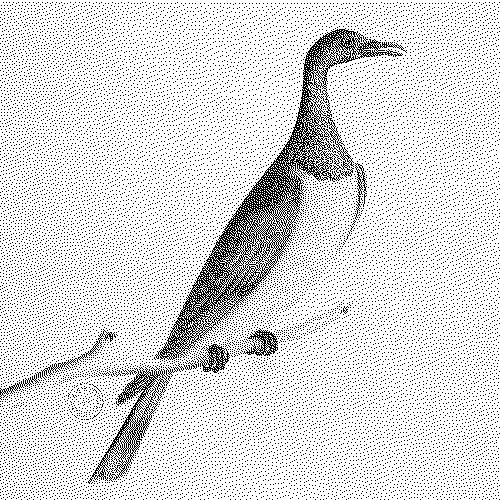
Abstract
This article re-examines the authorship and production context of the so-called Sydney Set (PXD 226), a significant album of natural history drawings from the early years of the British colony at Port Jackson, Australia. While recent scholarship has identified stylistic affinities with Indian art and suggested that the works may have been produced in Sydney Cove, questions remain regarding the identity of the artists themselves. Drawing on material, stylistic, and archival evidence—including paper analysis, the use of metallic pigments, and the circulation of related botanical and ornithological images—the article argues that Indian artists were active in Sydney Cove in the early 1790s. By reconstructing the movement of objects, images, and ships across the Indian Ocean, it situates these works within a wider network of colonial exchange. In doing so, it challenges established narratives of early Australian art and reconsiders the spatial limits of “company painting”.
Introduction
One of the earliest and most striking images of the Norfolk Island pigeon, extinct since about 1900, is from an album of watercolour paintings entitled “Collection 27: Drawings of Birds Chiefly from Australia, 1791–1792” in the Mitchell Library at the State Library of New South Wales (fig. 1). The album is also known as PXD 226 after its earliest listing in the library. It is one of the institution’s most important treasures, dating back to the founding years of the British colony of Port Jackson (modern-day Sydney), where the principal settlement at Sydney Cove marked the first permanent European outpost in Australia. The period is associated in particular with the First Fleet, the name given to the expeditionary voyage that transported convicts to what was then known as New Holland and that established the settlement in January 1788.
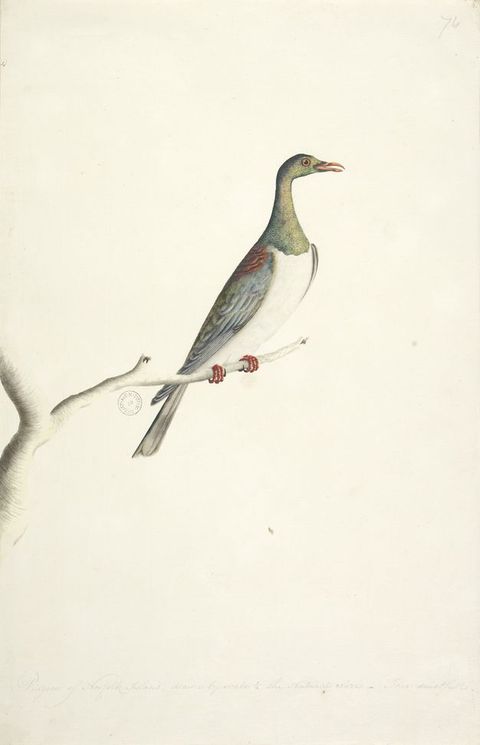
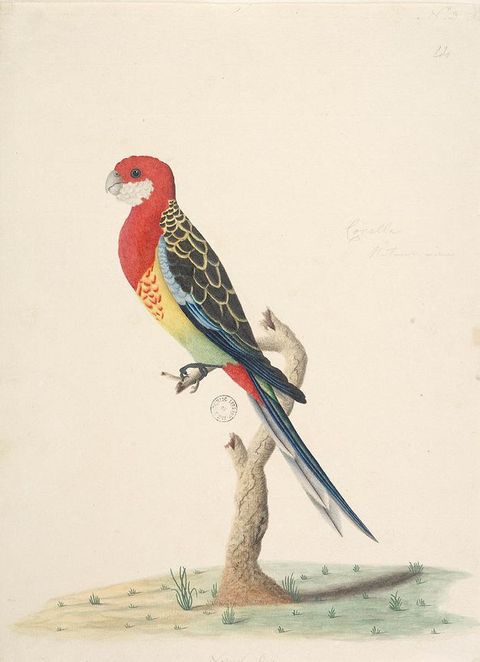
Most of the watercolours in PXD 226 are remarkable for their technical brilliance and their refined compositional arrangements, as we find in the pleasing arrangement of the three birds, White-Naped Honeyeater; Yellow Robin; Eastern Spinebill (fig. 2). The works also display an extraordinary chromatic range, as in the brilliantly coloured Eastern Rosella (fig. 3). In both images, the birds perch on a support that is more reminiscent of dead coral or macerated bone than the branch of any tree. The outlines of their bodies form sharply defined silhouettes, drawing attention to the negative space around them, while individual blocks of colour mark out broad shapes within those silhouettes that are carefully organised in relation to the overarching form. In both images these forms are set against a large expanse of cream-coloured paper. While there are annotations written in pencil on several of the works, including occasional references to the birds’ Indigenous names, there is, frustratingly, nothing to help us identify the maker. While the stylistic evidence suggests that the same artist who painted Eastern Rosella produced Pidgeon of Norfolk Island, the album in general appears to be the output of more than one artist. In his important study, A Rage for Curiosity: Visualising Australia, 1788–1830, Richard Neville recognised in the contents of PXD 226 the work of at least three artists, who, for convenience’s sake, he called the “Sydney Bird Painters”.1
1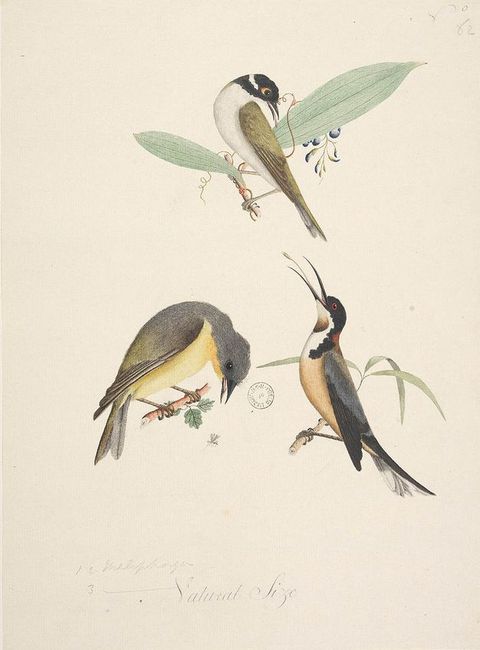
In this article I argue that at least some of the artists responsible for these works were Indian painters working in Sydney Cove in the early 1790s. Drawing on stylistic analysis, material evidence, and maritime history, I propose that these paintings emerged from artistic and commercial networks that linked Port Jackson to the wider Indian Ocean world. Beyond questions of attribution, my argument has broader implications for the study of early Australian art and for scholarship on so-called “company painting”, suggesting that the visual cultures associated with the East India Company extended beyond the Indian subcontinent and were shaped through transcultural and transoceanic exchanges. The wider maritime geography within which these exchanges took place, linking (as I shall argue) Port Jackson to Batavia and Calcutta (Kolkata), is illustrated in a map engraved by John Russell, after the work of the French cartographer Jean-Denis Barbié du Bocage (fig. 4). The same map was included in the atlas volume to Jacques Labillardière’s account of Bruni d’Entrecasteaux’s voyage to the Pacific (1791–94).2
2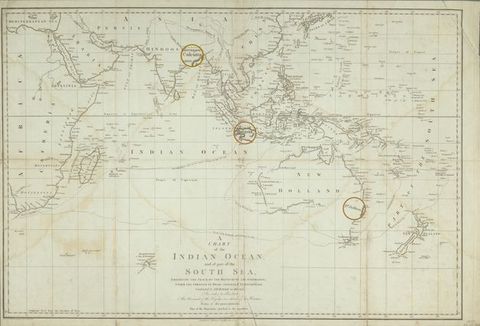
Another notable feature of the works in PXD 226 is the use of gold leaf and metallic paint to capture the iridescence of some of the birds’ plumage, including the Norfolk Island pigeon. To the island’s early British visitors, the bird would have appeared both familiar and exotic because of the far more extensive spread of iridescent feathers covering its head, neck, and breast than is found in common European varieties. Only the moving image can come close to conveying the visual effects of gold leaf in the Sydney Bird Painter’s image, treated in such a way as to imitate the feathers’ brilliant shimmer (fig. 5). Pidgeon of Norfolk Island stands as an example of what, in the context of early modern Mexican featherwork, Brendan McMahon describes as a “contingent image”.3 Like those feather mosaics, the diversity of hues produced around the gold leaf can be perceived only by looking at it from different angles: “specific angles”, as McMahon puts it, “described by the physical relationship between the object itself, the observer, and the illuminant”.4 A similar triadic relationship is evoked in a series of observations on the topic of “Subjective Halos” in Johann Wolfgang von Goethe’s Theory of Colours.5 Describing the light effect created by sunshine on a piece of gold leaf, Goethe likens the “variegated rays” of the halo that appear around it to the “iridescent appearance” produced in the eye when sunlight passes through the leaves of trees. This effect, he maintains, is “the result of the conflict between light and a living surface”. Of course, it is in the mind of the viewing subject that the conflict takes its shape, a shape that, according to Goethe, is always circular. Like the undulating waves of water after a stone is thrown into a still pond or the “intermitting pulsations” that are felt at the sound of the tolling of bells, the halo “has already a circular principle in its organisation”.6 In the work of the Sydney Bird Painter, the optical instability of gold leaf provides an apt figure: its dependence on movement, light, and position mirrors the geographic mobility that conditions the production of these images and, more poetically, intimates glints of interpretative possibility that intermittently come into view.
3The disc-shaped character of Goethe’s subjective halo is echoed in the shamsa—from the Persian for “little sun”—a divine light that appears as a sunburst in Mughal works of art, in which the use of gold leaf is often prominent.7 Shamsas frequently appear on the opening page of a manuscript, sometimes containing the owner’s name, often that of the Mughal emperor himself.8 The use of gold in this context takes on a symbolic function, equating the material with spiritual illumination.9 These associations may seem quite out of keeping in relation to the depiction of birds native to a colonial British outpost thousands of miles from India, which were ostensibly produced for the advancement of scientific knowledge. Yet such transcultural images are not without precedent in this period.
7The same techniques of applying gold on paper evidenced in the most dazzling works of Mughal art can be found among the thousands of natural history paintings produced under East India Company patronage. An important and substantial collection of such works was amassed by Richard Colley Wellesley, governor-general of India between 1798 and 1805.10 Like the examples in PXD 226, a painting from his collection, Two Sides of a Bengal River Fish, uses gold to convey the iridescence of the fish’s scales (fig. 6).
10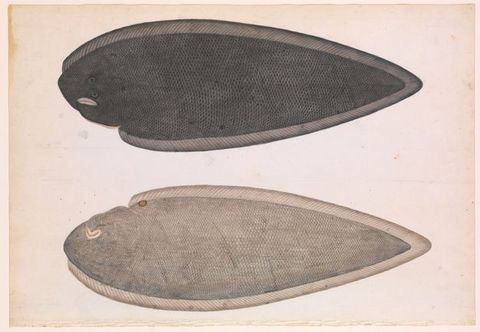
It is worth noting here that the term “Company School”, under which works like this have often been grouped, has been criticised as a retrospective category. The term is also highly imprecise, as recent scholarship has shown, for as a catch-all it obscures the diversity, mobility, and regional specificity of artistic practices across South Asia.11 One implication of the argument presented here—that a group of Indian artists were active in Sydney Cove in the early 1790s, and that their presence can be reconstructed through a combination of stylistic, material, and logistical evidence—is that it places further critical pressure on the term.
11It was Neville who first suggested an association of the work in PXD 226 with Indian art. Initially, he proposed that the artists were working outside Port Jackson, drawing specimens that had been sent from Sydney Cove to India. To support this proposition, he pointed to the lack of anatomical accuracy in the depiction of many of the birds in PXD 226; for example, the elongated neck of the Norfolk pigeon indicates that their knowledge of Australian ornithology was limited to the examination of imported skins.12 More recently, however, on the grounds that some of the images were copied by artists whom we can be quite sure were in the colony at the time and whose works are found in the Watling Collection in the Natural History Museum, London, Neville has tentatively suggested that they may have been produced in Sydney Cove.13 What follows is a close engagement with Neville’s proposition. The arguments also pick up on ideas and sources presented in Louise Anemaat’s book, Natural Curiosity: Unseen Art of the First Fleet.14 Broadly speaking, Neville’s work, together with Anemaat’s important study, constitute the most comprehensive and coherent examination of early Australian natural history painting up to the present. Crucially, Anemaat’s work draws attention to another extraordinary collection of watercolours, the Ducie Collection, which has only recently (in 2005) been acquired by the National Library of Australia.15 The collection provides new evidence to support not only the notion of an Indian presence in the First Fleet archive but also essentially my main contention in this article, that these Indian artists actually resided in Sydney Cove for a considerable time.
12To deal with the treatment of the bodies of dead animals and plants, some of which are now extinct, to engage with the canon of early Australian natural history painting, is in some measure to become aware of their loss. There is a mournful character about the notion of the archive itself, as the cultural historian Stuart Hall argues, conceiving of the archival act as representing “the end of a certain kind of creative innocence, and the beginning of a new stage of self-consciousness”.16 Historians have tended to overlook the affective nature of these artworks, in contrast to the attention they give to First Fleet artists’ depictions of people. Discussion of natural history paintings has instead tended to focus on the individuals, members of the British elite, who commissioned them, thus (albeit inadvertently) reinforcing the traditional role of the imperial male “expert” in determining what counts as scientific knowledge. Such an approach is difficult to avoid, given how almost all the surviving textual information regarding these images is found in the personal correspondences of such men. The content, date, and movement of letters certainly form a vital part of the story and are necessary for getting the timelines straight, but timelines alone cannot fully account for the strange visual and affective charge of these works. Like the iridescent haloes produced by the gold leaf in the Sydney Bird Painters’ images, the archive yields only partial illuminations: fleeting impressions that emerge through movement, relation, and changing points of view. My argument here therefore proceeds not only through chronology and logistics but also through attention to those unstable optical effects that register the transcultural conditions of the paintings’ production.
16PXD 226 and the Indian Connection
The collection PXD 226 was purchased by the Public Library of New South Wales from a London bookseller in 1887. After it was transferred to the Mitchell Library, a specialised section of the library, in 1929, the ornithologist Keith Hindwood was invited to examine it, the first person to do so since it had been acquired.17 Describing it as the “Sydney” set, Hindwood advances the intriguing hypothesis that the album once belonged to Arthur Phillip, the first governor of New South Wales. Phillip led the establishment of the penal colony at Sydney Cove, shaped its early development, and supported the production and collection of artworks and natural history specimens.18 Hindwood’s theory hangs on three propositions. The first, founded on two dates that appear on two separate works in the collection—“December 1791” and “June 1792”—is that the paintings were produced while Phillip was in the country, between 19 January 1788 and 11 December 1792.19 A necessary caveat to this claim is communicated in the full wording of one of these inscriptions, written underneath a drawing of a wonga pigeon: “Drawn by scale ½ the natural size. Two of these Pidgeons were now seen for the first time in December 1791”.20 This reference to the first sighting of the bird suggests that the dates given do not necessarily relate to when the painting was produced, which may have been many months later. The second of Hindwood’s propositions is that Phillip had these drawings in his possession when he died—the same works, he contends, that Phillip described as having been “made in New South Wales” in his will and that were sold at auction in July 1815, a year after his death, in a lot consisting of “490 drawings of birds, animals, reptiles, flowers, plants, and ‘Portraits of several Natives’ and ‘A Panoramic View of Sydney’”.21 Hindwood’s final proposition is that some annotations on the drawings in PXD 226 are written in Phillip’s hand, attesting to his ownership of them.22 He does not, however, specify on which of the album’s drawings these inscriptions appear, and no formal analysis has been undertaken. Nevertheless, a comment on the bird’s “very uncommon & not unpleasant note”, for example, written beneath a drawing of a black-backed magpie, does display graphological features consistent with those in Phillip’s letters.23
17Neville’s suggestion of an Indian connection with the Sydney Bird Painters does not contradict Hindwood’s propositions. A letter sent by Phillip to Charles, 1st Marquis Cornwallis, then governor-general of India, in March 1791 indicates that ongoing discussions were taking place between the two men on the subject of trade between the colonies around the time the album was created.24 Also at that time natural history paintings by skilled Indian artists were prized by British colonists. Works of a similar, if not often finer, quality than those in PXD 226 were certainly being produced for East India Company officials with an interest in natural history in its administrative centres in Madras (Chennai), Bombay (Mumbai), and the newly developed Calcutta.25 Research into Indian plants and animals was seen as a way of contributing to the East India Company’s mission. The discovery and definition of new species provided opportunities both to instrumentalise potentially lucrative raw materials and to offer the company’s self-styled patrician elite a useful and improving pastime.
24Just as in Port Jackson, where natural history collectors made use of Indigenous understanding and practical expertise, company employees in India used local knowledge to gather zoological and botanical information.26 In Madras (Chennai), successive holders of the position of the company’s “botanist in the Carnatic”, Patrick Russell (1785–89), William Roxburgh (1789–93), and Benjamin Heyne (1793–1819), all commissioned local artists to produce paintings of plants.27 Roxburgh’s collections provided the illustrations for his foundational study of Indian botany, Plants of the Coast of Coromandel.28 James Kerr, an avid student of natural history who served as an assistant surgeon in the company, was assigned to Patna (Azimabad), the old capital of the former province of Bihar in the 1770s, where he paid local artists to produce hundreds of plant drawings.29 It appears to have been through Kerr’s recommendation that the painter Das Bhawani came to the attention of Chief Justice Elijah Impey and his wife, Martha Impey, in the 1780s, who commissioned him to produce images of animals in their menagerie.30 During this period, many Patnakalam painters travelled to Calcutta, where the Impeys resided, including another Hindu artist, Ram Das, and the Muslim Shaikh Zain-al-Din, both of whom contributed works to the famous Impey Album.31 From 1776 until his death in 1800, the enterprising company officer and indigo planter Claude Martin was another important patron of Indian art, commissioning many works, including ornithological images, from local artists.32 Martin lived in Lucknow, the capital of Oudh and, like Patna, one of the great cultural centres of the Mughal Empire.
26By the turn of the nineteenth century Indian artists were also commissioned to draw specimens that came through Calcutta from Port Jackson, including the three images of lyrebirds in Wellesley’s collection, one of which is a painting of a female, Superb Lyrebird (fig. 7).33 Among the numerous specimens in the Natural History Museum in Tring is a young male with a label attached to one of its legs attesting to its having been presented to the British Museum by the collector Major-General Thomas Hardwicke.34 Hardwicke was a soldier in the service of the East India Company from 1778 to 1823.35 During that time he amassed a large assemblage of natural history specimens, as well as a collection of thousands of paintings by Indian artists, both of which he bequeathed to the British Museum on his death in 1835.36 The Hardwicke Collection of drawings in the Natural History Museum, formerly at the British Museum, includes examples of Australian birds.37 Some of these drawings could have been done much earlier than the date of the Hardwicke bequest. It is certainly possible that the images of the lyrebird in Wellesley’s album have some connection to Hardwicke, for Wellesley did acquire drawings from him during his time as governor.38 It is unclear when and how the lyrebird in Tring came into Hardwicke’s possession. Though it is conceivable, any connections between this specimen and the Wellesley drawings would be merely conjectural, given the current lack of evidence. The potential synchronicity in terms of when these items entered the colonial Indian archive does raise the possibility that, from around the beginning of the nineteenth century onwards, specimens of Australian birds were being imported into India and were being drawn by Indian artists. It would be difficult to push this practice back to the first two years of the 1790s, however, to the period when the Sydney Bird Painters were active.
33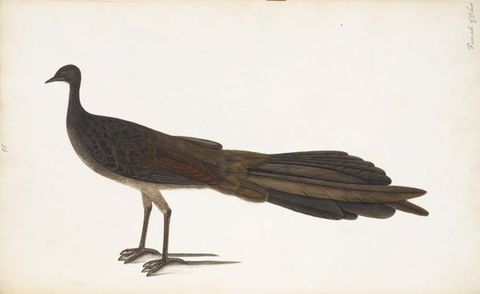
In the history of the colony, the paintings in PXD 226 belong to “the hungry years”, before there was any official trade between India and Port Jackson. The first ship recorded to have departed Port Jackson for India was the Atlantic, which left on 26 October 1791, heading for Calcutta.39 Two months later, on 3 December, the Albemarle and the Active also sailed for India, destined for Bombay.40 Considering the possibility that the specimens depicted in PXD 226 were sent to India to be painted, and thus disproving the idea that Indian artists lived and worked in Sydney Cove in the early 1790s, it seems improbable that the specimens were transported on any of these vessels, as the two dates provided in the album come after their departures. The specimens might have been taken on the next ship travelling to India, the trading vessel Shah Hormuzear, which left the colony on 24 April 1793, headed for Bombay.41 Shah Hormuzear certainly fits the timeline better, pushing forward the date the album was produced to sometime after 1 February 1794, when the ship arrived in Bombay.42 This timescale, however, would seem to take Phillip out of the picture, the man whom Hindwood argued commissioned the works, who left the colony on 11 December 1792.43
39Another issue is the question of style. Considering the ship’s ultimate destination, the formal qualities of the Sydney Bird Painters’ work are more closely aligned to the artistic output from east Indian cultural centres, including Calcutta, Murshidabad, and Patna, than to works from west India where Shah Hormuzear was headed. Finally, some consideration needs also to be paid to the state of natural history painting at the time in Sydney Cove. In October 1792 Thomas Watling, a professional artist, arrived in Port Jackson.44 He was soon set to work producing paintings of the local fauna.45 Why, in early 1793, would specimens be sent to India to be drawn when a competent natural history artist was being employed to produce such drawings in the colony?
44Cumberland Trees
If the preceding discussion raises doubts about the travelling specimen thesis, the botanical drawings provide a different kind of evidence: not merely stylistic affinities with Indian painting, but also indications that artists trained in north Indian workshop traditions were physically present in the colony. Against the travelling specimen thesis, there is the traveller artist one. The movement of colonised people across the Indian Ocean was not yet widespread in the 1790s. Devleena Ghosh and Stephen Muecke observe that it was not until the nineteenth century that the movement, or forced movement, of people around these maritime spaces became more extensive and commercially driven.46 Nevertheless, there are some known examples of Indian artists travelling outside of India closer to the turn of the century, including the Bengali painter Haludar, who probably accompanied the physician, botanist, and surveyor Francis Buchanan-Hamilton on part of his surveys of Chittagong, Mysore, and Nepal between 1798 and 1803.47 The Patnakalam artist Manu Lal is also known to have travelled with Richard Parry, a former employee of the company treasury, to Sumatra, where between 1807 and 1811 he produced 202 drawings of plants and animals, including birds, which Parry presented to the East India Company Office in London in 1812.48
46There is thus some precedent to support the idea that at the end of the eighteenth century Indian artists could have travelled as far as Australia. Several material factors also bolster this proposition. The first relates to the character of the paper used by the Sydney Bird Painters. In the early 2010s Anemaat looked closely at a wide range of works on paper depicting the natural history of the colony over a fairly defined span of years, from around 1788 to 1794.49 This analysis includes work by artists whom we can be quite sure were working in Sydney Cove at the time, including the album of botanical drawings attributed to the convict artist John Doody, who arrived on the Admiral Barrington on 16 October 1791.50 Comparing the paper in this and other albums with that in PXD 226, Anemaat identifies certain consistencies.51 The paper available in the colony came in limited consignments. Some of the sheets in PXD 226 not only originated from the same paper mill but also from the same paper mould. It is likely that this paper was from a single consignment purchased and transported as a job lot and brought to Port Jackson.52 Anemaat concludes that this material connection between the drawings provides “the strongest indication we have” that the Sydney Bird Painters were working in Sydney Cove when they made these drawings.53 Neville also raises the point that copies of the Sydney Bird Painters’ work are included in the Watling Collection.54 The copyist must have had the original to refer to, which suggests that these works were in the colony prior to that date.
49Other evidence includes two letters Phillip sent to Sir Joseph Banks, then president of the Royal Society, and a drawing of a tree, Clerodendrum floribundum, known colloquially as the smooth spider-bush or the lolly bush, or, as Phillip named it in the 1790s, the Cumberland tree (after the duchess of Cumberland, Anne Luttrell, wife of King George III’s brother). The tree is referred to in a letter Phillip sent on 13 April 1790, the first of two to Banks that touch on the subject, where he wrote: “The Seed of the Duchess or Cumberland Tree, are just gather’d, the Tree flowers in february, March & April. I am now getting drawings of all the flowering Shrubs in this Country, & which with the Shrubs dried, may when I return give an information which my ignorance in botany prevents”.55
55The second letter, which also discusses the Cumberland tree, was sent around twenty months later, on 3 December 1791. Phillip wrote again about employing natural history artists: “I am getting drawings of all the plants & animals, they are done correctly, & about two hundred are finished”.56 Phillip made good the promise from his earlier letter, sending with the missive a box containing seeds of the tree and a drawing of it.57 Cumberland Tree in the Dixson Library, another specialised unit of the State Library of New South Wales, has been identified as the picture that Phillip sent, a sheet presenting various views of the tree (fig. 8).58 Phillip asked Banks to have it copied by “one of the best artists in town [London]”, framed, and sent to the duchess after whom it was named.59 Unfortunately, as there is no signature on the work, it is still a matter of speculation as to who produced it.60 In addition to a full view of the tree, the study also contains an image of the distinctive red calyces and black berries—a colourful combination from which it later derived its common name, the lolly bush—both in clusters on a branch and in a separate drawing of a single berry revealing the seeds within. The sheet also includes a large-scale view of a leaf and a detailed drawing of its white flowers, a single, detached example of which is shown in another inset broken down into parts, highlighting its stamens and pistils. In this latter study, in particular, which highlights the male and female reproductive parts of the tree’s flower, the botanical details are “done correctly”, that is, in accordance with Carl Linnaeus’s classificatory system, which Banks, as a Linnaean botanist, would certainly have expected others to follow.61
56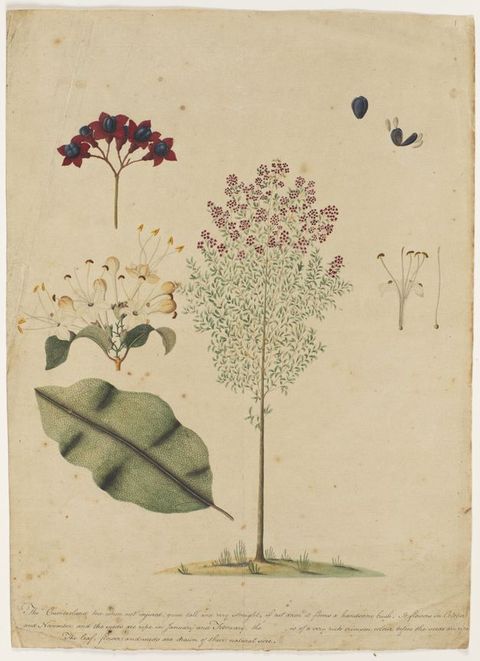
Across the archive, there are two works that are clearly closely related to Cumberland Tree. The first is an image from the Ducie Collection in the National Library of Australia, Smooth Spider-Bush (Clerodendrum floribundum), attributed (questionably) to George Raper (fig. 9). The other is from the Watling Collection, Cumberland Tree, attributed to the Port Jackson Painter, a generic moniker used to describe the work of probably several artists, which makes up the bulk of that collection (fig. 10). A case can be made on stylistic grounds that the same artist was responsible for all three images. It certainly looks as though whoever produced the version that was sent to Banks had the two other paintings in front of them as points of reference. From the Ducie version, they copied the flowers to the left, and the stamen and pistils to the right.62 From the Watling version they took the fuller row of berries. The Ducie version also features at the bottom a drawing of the tree’s roots, which does not appear in either of the other versions. The relationship between the three images is intriguing. If we were to draw them together, the weakest element, at least by the standards of botanical illustration, is the tree in flower, which appears schematic in comparison to the detailed studies around it. Bearing in mind Phillip’s comments about the Cumberland tree flowering in February, March, and April, it is reasonable to assume that the two detailed studies were produced sometime during those months. Perhaps only later, closer to the time of Phillip’s letter to Banks in early December, was the artist tasked with producing a comprehensive profile of the tree. While their early studies had helped them to describe its various individual parts, they could only draw on memory for the full flowering form.
62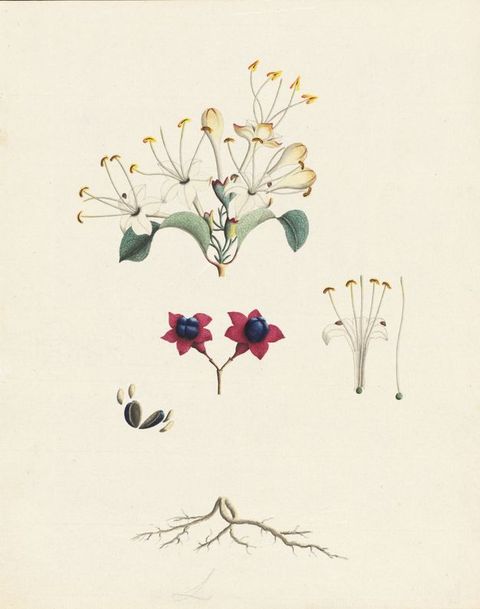
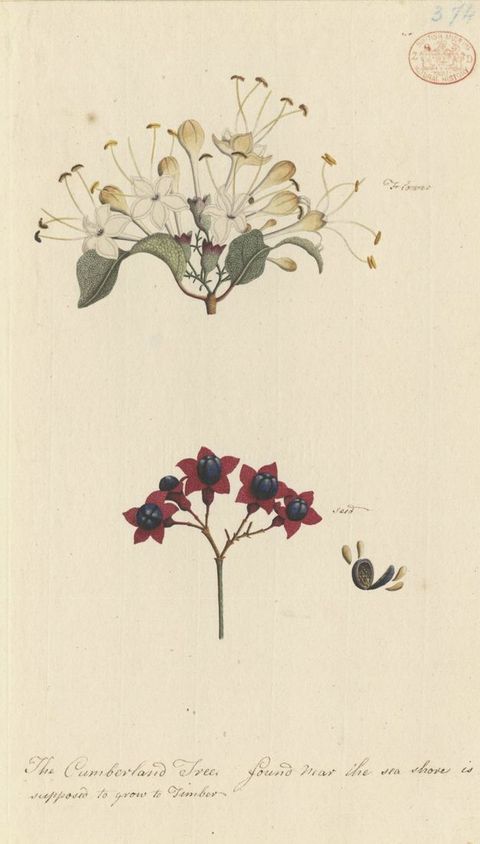
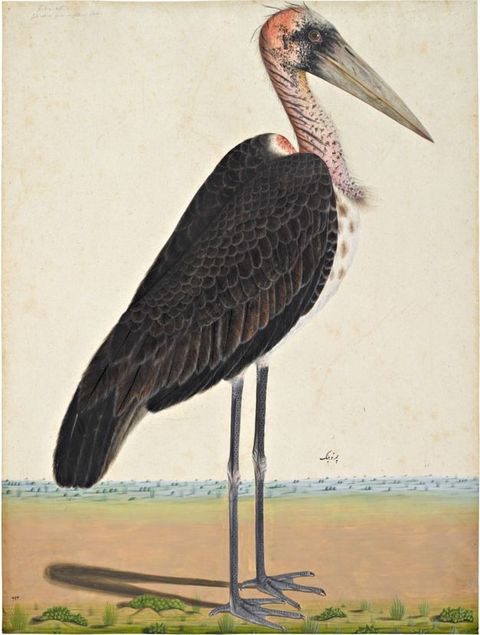
Several stylistic features in these three drawings recall some of the works in PXD 226. Like the Australian ornithological paintings we have examined so far, with their vibrant colours, these drawings are also characterised by remarkably fluid and precise lines, and an expert use of the watercolour medium, with their fine details achieved through the use of squirrel-hair brushes. Secondly, the treatment of the grass-covered mound at the base of the Dixson Library’s Cumberland Tree (see fig. 8), including the distinctive clutches of stalks sprouting about it and the strong shadows they cast, prompts comparisons with the ground in Eastern Rosella (see fig. 3). There is also the modulation of tone from yellow to the left to green to the right. All these features appear in the miniature landscapes in which birds and animals are shown in works by artists working in Lucknow at this time, for example A Lesser Adjutant Stork (Leptoptilos javanicus) in a Landscape, which was formerly part of Claude Martin’s collection (fig. 11).
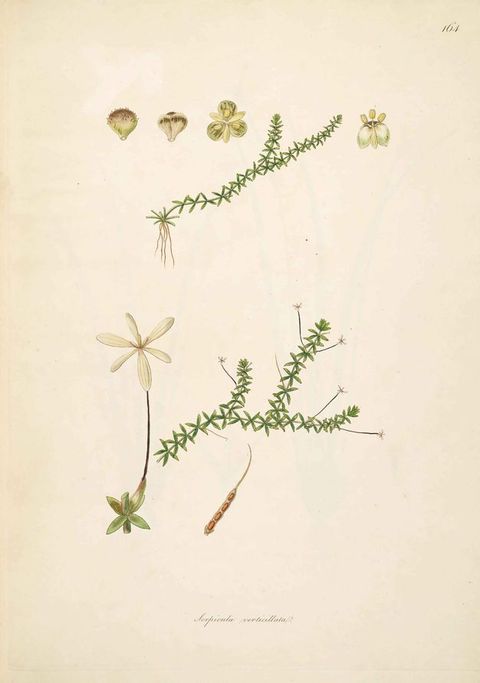
Comparisons can also be drawn with the many illustrations in Roxburgh’s Plants of the Coast of Coromandel. Serpicula verticillata is a hand-coloured print produced after a drawing by an Indian artist, featured in the second volume (fig. 12). In 1793 Roxburgh was given the role of superintendent of the Botanical Gardens at Calcutta, where he worked on his survey of India’s flora and recruited and trained a team of local artists to draw every species of plants listed in it.63 As part of that training, Roxburgh would have shown these artists illustrations from William Curtis’s Flora Londinensis made by James Sowerby and others.64 The presentation of the plant Serpicula verticillata alongside its segregated parts follows that model. There are notable variations, however. In Curtis’s images the seeds, flowers, and fruits are invariably placed beneath a picture of the entire plant, in relation to which they appear much smaller to approximate a sense of scale. In the Roxburgh image, in contrast, the arrangement is more improvised. Various parts of the plant are positioned in both the upper and the lower registers. There is a pleasing relationship between these two registers, particularly in the repeated forms of the plant’s leaves and branches. Similar improvisations are evidenced in the three watercolours from Australia. Note how, in the Ducie and Watling images, the flowers echo the curve of the leaves above them. This concern with symmetry is registered in the figure of the tree itself in the Dixson Library version, prompting comparisons with the bilateral symmetry in Mughal manuscripts and textiles. Taken together, these stylistic similarities, the images’ refined detail, their idiosyncratic miniature landscapes, the emphasis on bilateral symmetry, and the uneven treatment of scale point beyond coincidence to a shared visual language consistent with north Indian workshop practice.
63If the artists who produced the Australian drawings were indeed Indian, the significance of the botanical paintings takes on particular weight. Unlike birds that could be transported as skins, if not alive, it was difficult and perhaps impossible at the time to transport flowering plants across as large an expanse of ocean as that separating Port Jackson and Calcutta.65 The depiction of these flowers thus situates the artists firmly in Sydney Cove.
65Questions as to how, why, and when these artists arrived in Port Jackson can be approached by tracing the movements of the images themselves, both as visual markers registering the presence of other images, as in the different representations of the Cumberland tree, and as physical objects transported across maritime spaces. In the latter case, the Dixson Library drawing (see fig. 8) was probably sent on the Gorgon, as Phillip indicates in his letter to Banks.66 The ship left Port Jackson on 18 December 1791.67 As mentioned earlier, the Watling Collection, which includes the drawing of the different parts of the tree, almost certainly left the settlement at the end of 1794 (see fig. 10). There is less certainty surrounding the movements of the drawing in the Ducie Collection (see fig. 9). This album, which consists of fifty-three unsigned watercolours of Australian birds and flowers, was acquired by Francis Reynolds, 3rd Baron Ducie, in 1792 and so must have left Port Jackson before that date.68 If, as suggested above, the Dixson Library drawing was drawn with direct reference to the Ducie version, and produced after the tree had flowered in the spring of 1791, at a date closer to when Phillip wrote his letter to Banks in December, it seems probable that the Ducie Collection as a whole travelled on the Gorgon, which reached England in June 1792.69 Another smaller collection of botanical drawings, known as the Ross Set and now in the Linnean Society, may also have travelled on the Gorgon, under the charge of Major Robert Ross.70
66The Ducie Collection
As well as splendid original botanical studies, the Ducie Collection also holds eighteen works that appear to be copied from Captain John Hunter’s sketchbook, “Birds & Flowers of New South Wales drawn on the spot in 1788, '89 & '90”, which is likewise housed in the National Library of Australia.71 The case for these versions being copies, as opposed to the original visual sources from which Hunter worked, cannot be established conclusively. There is no doubt, however, as to the higher quality of draughtsmanship in the Ducie Collection. Take Hunter’s drawing Brush Bronzewing (Phaps elegans) and Sweet Pittosporum (Pittosporum undulatum), which shows the bird perched on a tree with fruits and leaves (fig. 13).72 The Ducie version, Brush bronzewing (Phaps elegans), Male (1788?), is in many ways more convincing (fig. 14). Note how the artist has positioned the bird’s head to overlap with the leaves behind, casting a slight shadow over it and generally creating a greater sense of pictorial depth than the much flatter looking work by Hunter. The size of the flowers in proportion to the fruit is also more accurate. One might expect a copy to result in a loss of accuracy, being further removed from the original model. A counterargument is that the copyist, particularly if skilled, would be employed to improve on the original. In this particular drawing, these improvements add greater modelling and texture through the addition of Dutch metal leaf on the bird’s wing feathers; additional plant forms have also been introduced. If Hunter were copying from this image, would he not have included these plants too?
71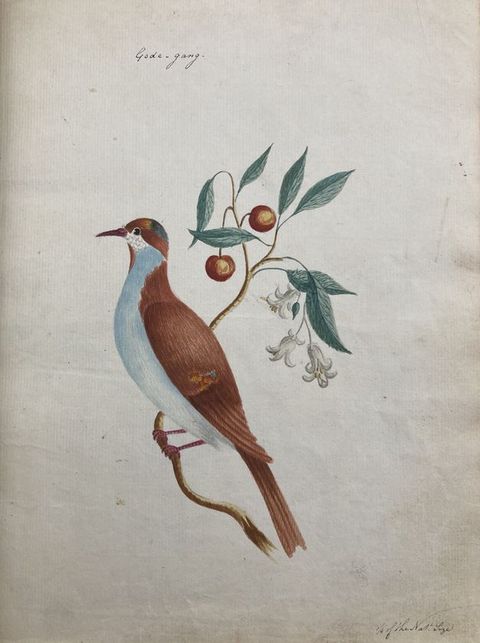
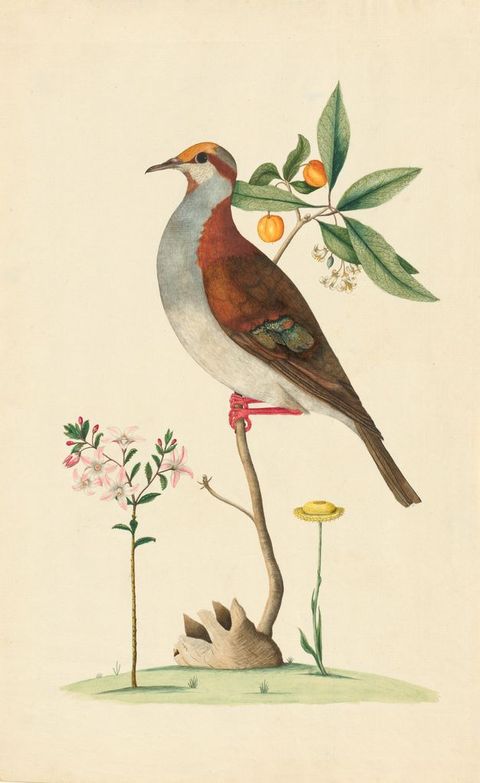
The pose and plumage of Hunter’s bird are very similar to the Sydney Bird Painter’s Bronze Winged Pigeon, one of around ten works that also appear to be based on drawings in Hunter’s sketchbook (fig. 15). As with the Ducie version, this painting also uses metallic paint to convey the iridescence of the bird’s feathers. Departing from that version and Hunter’s own, however, there is no patch of amber on the bird’s forehead. As with other variations of Hunter’s work in PXD 226, there is a sense here that the artist is referring both to the naval officer’s paintings and to a physical specimen, demonstrating another way in which these artists might have sought to improve on the original and perhaps to outdo each other.
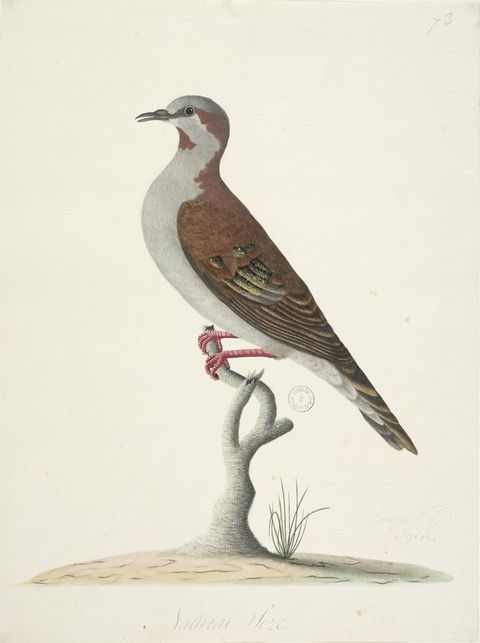
Whether these are copies of Hunter’s work or were copied by Hunter, the images would certainly place these highly skilled artists in the colony at a time before Hunter departed for England on 28 March 1791, presumably taking his sketchbook with him.73 The copies could not have been produced overnight; they would have taken weeks. How long before Hunter’s departure might the artists who produced them have arrived? Phillip tells Banks in the letter he sent him in April 1790 that he was “now getting drawings of all the flowering Shrubs in this Country”. Could it be that they were there already even then?
73There are factors, however, that speak against the presence of professional artists in the colony in the spring of 1790. While it is incontestable that Phillip already had “about two hundred” drawings done for him by December 1791, it is curious that he does not refer to any particular drawings in his April letter or append any to it as he does with the later letter; instead he promises only to show these to Banks on his return to England. Also, while 200 drawings is a substantial number, it is less impressive if produced over the course of twenty months, the length of time between the two letters, and by multiple artists working, one assumes, simultaneously. Might it be that the phrase in the April letter “now getting drawings” referred not to an accomplished fact but to an intended outcome; for “getting” read “going to get”? As for the word “now”, why now? What was happening at the time he wrote the letter?
The Supply
The remaining question is how such artists might have arrived in Sydney Cove during the colony’s early years. The answer may lie in the emergency trading networks established after the maritime disasters of 1790. The letter in question was dispatched three days after it was written, on 17 April, aboard the storeship HMAT Supply, which, unusually, was heading out not west towards the Cape nor east towards Rio de Janeiro, but north to the nearest major European trading port, Batavia.74 It was entrusted to Lieutenant-Governor Philip Gidley King, who, after arriving in Batavia, sailed to the Cape on a ship called the Snelheid, a Dutch vessel that the British had apparently chartered there.75 It arrived in England on 19 December 1790, reaching London three days later.76 While King embarked on his journey to the Cape, in Batavia the Supply, under the captaincy of Lieutenant Henry Lidgbird Ball, was loaded with much needed provisions for the colony. This trip to Batavia had been undertaken as an emergency measure, the consequence of two earlier maritime disasters, the more immediate of which was the loss of HMS Sirius.
74Sirius, commanded by Hunter, had left Port Jackson on 5 March 1790, carrying supplies for the new settlement of Norfolk Island.77 On 19 March 1790 bad weather drove the vessel onto a reef off the coast of the island, ripping its hull.78 Hunter, together with the rest of the crew, including the naval officer and amateur natural history painter Lieutenant George Raper, was stranded on the island until they finally returned on 26 February 1791, a little over a month before they and other crew members of the Sirius, left the colony on 28 March.79 This narrow window of time raises questions as to when the artists represented in the Ducie Collection and PXD 226 could have produced their copies of Hunter’s paintings. Was it during the course of that month, between February and March 1791? One factor that complicates this proposal is the notable absence of copies in both collections of any works that Hunter produced while he was stranded in Norfolk Island. The one exception to this is the Pigeon of Norfolk Island, which I shall return to later (fig. 16). The evidence would thus point to the drawings having been done either prior to the departure of the Sirius on 5 March 1790 or, taking up the possibility that Hunter left his completed sketches in Sydney Cove, in his absence. The first proposition would push the arrival of these artists to at least February 1790, if not considerably earlier, that is long before the earliest date given in PXD 226 of December 1791. Taken together, this evidence favours the second proposition.
77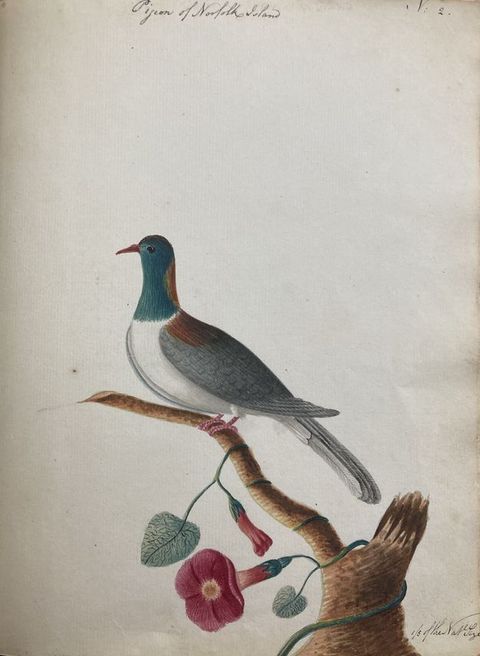
The other maritime disaster concerns the fate of HMS Guardian. This large storeship, bringing important provisions from England, was expected to arrive in Port Jackson in late January or early February 1790. By March, around the same time as news came of the wreck of Sirius, it was clear to the authorities that the ship had met with some disaster.80 It later emerged that the Guardian had struck an iceberg twelve days after leaving the Cape. This unfortunate event resulted not only in provisions vital for the settlers’ survival failing to arrive, but also in Phillip being deprived of a larger, more powerful ship to transport stores from Port Jackson to Norfolk Island and instead having to use the Sirius.81 After its loss, he had only the Supply, the smallest ship in the fleet, to call on to sail out and procure the essential provisions from Batavia. As the judicial officer David Collins declared, this small ship’s safe return was “their only remaining hope”.82
80The Supply reached Batavia on 6 July 1790.83 It stayed there until the end of August and returned on 19 October 1790.84 Overall the round trip took six months to complete, a month less than it had taken Hunter to sail to the Cape and back on the Sirius a year earlier.85 Phillip’s decision to send for supplies from Batavia instead of the Cape marked the beginning of a significant shift in the colony’s trading practices away from the British-dominated Atlantic towards the Indian Ocean and hence closer to trade with India itself. Official permission from London for the new settlement to engage in direct trade with India, however, was not granted until 6 September 1790.86 While the prospect of this trade was probably on the minds of Phillip and others in Port Jackson, until that permission was granted silence on such matters would have been advisable. If such a mission did take place before then, it would have had to have been undertaken unofficially, with a degree of secrecy. There is some evidence to suggest that this did happen. William Wyndham Grenville, then president of the Board of Control responsible for overseeing the East India Company, wrote to Phillip on 19 February 1791:
8387I find by letters which have lately been received from Calcutta, dated in the months of August and September last, that intelligence had reached India of the distress of the Guardian, and of the disappointment you were likely to experience in receiving supplies from hence, and that Lord Cornwallis had acceded to the proposals made to him by some merchants, of sending certain articles from thence for your relief.87
Travelling between May and September, when the monsoon winds would have aided the passage, a ship could have sailed from Batavia to Calcutta in roughly a month. It may not be coincidental that news of the colony’s distress, and the resulting entreaties from merchants in India to initiate a trading venture, appear to have followed soon after the Supply arrived in Batavia. If Indian artists were also sought at this point, and effectively employed, they would have travelled to Batavia in early to mid-August. From Batavia, their onward journey to Port Jackson could have followed two routes, via the Supply or by another means. The available evidence does not favour the first of these possibilities. The Supply departed Batavia towards the end of August. Assuming that a merchant ship set sail from Batavia in early July, immediately following the arrival of the Supply, it would not have been able to fetch provisions from Calcutta and return before the ship’s departure.
A more plausible candidate is another vessel chartered by Ball at Batavia, the Dutch snow Waaksamheyd. This ship reportedly left Batavia on 20 September and arrived in Port Jackson on 17 December.88 None of the contemporary accounts mention any artists on board, nor do they suggest any direct connection with India. The military officer Watkin Tench noted simply that the ship carried “a cargo of rice and salt”.89 The muted reception of the Waaksamheyd contrasts with the enthusiastic descriptions of the Supply’s return. Collins reported that it brought “several comforts” to the settlement that her captain, Ball, had supplied “with that attention to the wants of the different officers which always characterised him, having procured and taken on board their respective investments”.90 Tench was similarly delighted, declaring that Ball had filled the “little bark with every necessary and conveniency, which he judged we should first want”.91
88There are some questions that remain unanswered. First, in what capacity were these artists employed? Given the strict social hierarchy of Indian society at that time, it seems improbable that they would have travelled, as merchants did, in a speculative capacity. As noted earlier, Indian artists did travel but typically only in the employ of high-ranking East India Company officials. If Hindwood’s hypothesis that these paintings were commissioned and owned by Arthur Phillip is correct, they may have travelled in that capacity as employees of the governor himself. We might ask why nothing was said about their arrival or stay in the settlement. Aside from the obvious reason that trade between India and Port Jackson had not yet been officially endorsed, the settlement was also facing the real risk of starvation. At the same time as officers’ accounts were describing the deprivations experienced by the settler community, it was hardly fitting to talk of the resources being lavished on the production of natural history paintings. Whatever the case, the silence of the written record is countered by the visual evidence of the paintings themselves; their technical sophistication and the materials used in their production attest to their Indian origins.
As a final point, it could be said that the arrival of the artists fulfilled Phillip’s statement to Banks that he was “now getting drawings of all the flowering Shrubs in this Country” in more ways than one. At the time of writing the letter, he was indeed “now getting drawings” in the sense that he may already have arranged for capable artists to produce them. Four days after their arrival, on 21 December 1790, when Banks was presented with Phillip’s letter in London, the statement was even truer, given that by that date Phillip was indeed probably “now getting drawings” done.
Conclusion
Another question that remains is when these artists returned to India. It is possible they travelled to Calcutta on the Atlantic, which left Port Jackson at the end of June 1792, the month of the latest dated work in PXD 226. After 1792 a new phase of natural history painting emerged in the colony. Where the first phase, from 1788 to early 1791, is figured in the amateur works of Hunter and Raper, and the second phase, from late 1790 to 1792, in the highly refined works found mostly in PXD 226 and the Ducie Collection, the third phase, from late 1792 to 1794, which is marked particularly by the introduction of picturesque landscape settings, coincides with Watling’s arrival in October 1792 and is found in his works and in the contents of another striking album of paintings in the Mitchell Library, mostly of fish and birds, “Volume 04: Zoology of N. [New] Holland etc” (PXD 1098).92 Regarding the second phase, the preceding discussion invites as many questions as it answers. The artistic relationships suggested in the comparisons between works from the Ducie Collection and PXD 226 have yet to be explored. While Neville recognises the work of three or more artists in PXD 226, and Anemaat the work of three or more artists in the Ducie Collection, the comparisons that have been drawn here are not intended to suggest that there are straightforward correspondences between the two collections, as though they are both products of the same three or so artists.93 The relationship between the two is probably more complicated than that.
92Another fascinating relationship emerges in the overlap between the first and second phases of early Australian natural history painting, articulated in the copies or variations on Hunter’s paintings in PXD 226 and the Ducie Collection. Three or four works by Raper are also referenced in the latter.94 If, as has been proposed, these Indian artists had access to Hunter’s sketchbook while he was stranded in Norfolk Island, we may wonder what happened when he and Raper returned on 26 February 1791. They must have been impressed by the work they saw, particularly the artists’ use of gold leaf. Perhaps it was Hunter’s suggestion that a copy of his watercolour Pigeon of Norfolk Island be made, using gold to convey its beautiful iridescent head and neck, much as Ducie artists had used metallic paint to convey the iridescent plumage of the bronzewing pigeon (see fig. 16). Although done in reverse and with Hunter’s original attention to local flora abandoned, the general treatment of the subject matter in PXD 226, Pidgeon of Norfolk Island, including the elongated neck and the distribution of colours on its plumage, point to it being a copy of Hunter’s work (see fig. 1).95 The use of gold leaf is almost excessive here, indicating a conscious attempt to dazzle and delight.
94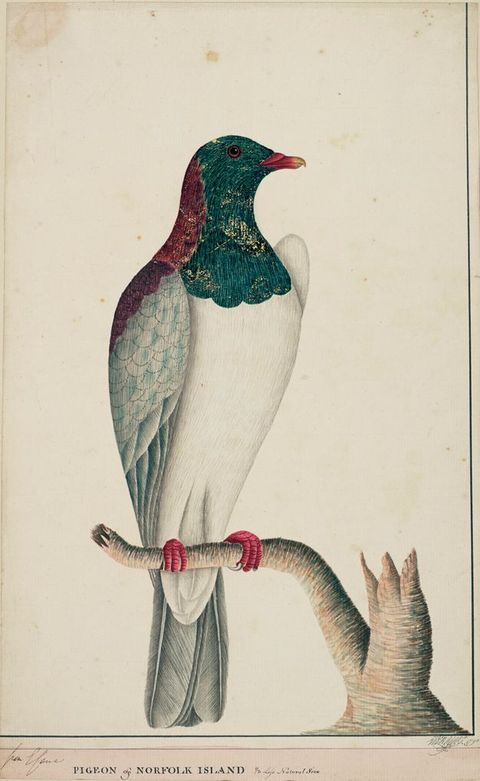
Raper also brought back a painting of the bird from his long stay on the island, Pigeon of Norfolk Island (1790) (fig. 17). Rather than have it copied, however, it seems that he sought to improve his image by applying metallic paint to it himself. Analysis has shown the metal he used to be the same type as was added to the wings of Brush Bronzewing, Dutch metal leaf (see fig. 14).96 As gold leaf, shell or saucer gold, and Dutch metal leaf were readily available in London, it may have be transported across the Indian Ocean on British ships or possibly through Dutch ships via Batavia. In any event, Raper’s use of it can hardly be described as successful. Much of the metallic paint has flaked off to reveal the finished watercolour image underneath. The application of the metallic leaf was clearly an afterthought and performed by an unskilled hand, unlike the expert use of it in the Sydney Bird Painter’s example, which remains dazzling even today. The painting, nevertheless, stands as an important work, a hybrid creation. Artistic mimicry, relentlessly characterised by the surfeit of multiples across the archives of early Australian natural history painting, plays out differently here. Here the copy does not stand as insurance against the loss of the original so much as evidence of the enchantment these works held for British observers.
96Taken together, the stylistic, material, and logistical evidence examined in this article strongly suggests that at least some of the works in PXD 226 were produced by Indian artists working in Sydney Cove in the early 1790s. The significance of this contention extends beyond questions of attribution. Recalling recent scholarship that has challenged the category of company painting as a stable and coherent designation, the Sydney example suggests that the range of the works it encompasses was not confined to the subcontinent but instead involved a wider network of exchange spanning the Indian Ocean, in which artists, materials, and visual conventions moved alongside ships, specimens, and texts. In this respect, the Sydney material resonates strongly with Holly Shaffer’s concept of “grafted arts”, which foregrounds the mobility of artistic practices and how visual forms were adapted through encounters across cultural and geographic boundaries.97 The works in PXD 226 and related collections might therefore be understood not simply as early examples of Australian natural history illustration nor as peripheral extensions of company painting, but as products of a transoceanic visual culture shaped by Indian artists whose presence in the archive has long been unrecognised. To recover that presence is not only to revise the history of art in early Sydney but also to rethink the spatial and conceptual limits of “company” art itself.
97Acknowledgements
This research was undertaken with the generous support of a Paul Mellon Centre Research Support Grant and a British Academy/Leverhulme Small Research Grant.
About the author
-
 Benjamin Pollitt is Lecturer in Art History at the University of Queensland. His research centres on British art, empire, and the affective economies of eighteenth- and nineteenth-century Pacific exploration. Recent publications include articles in Art History, Oxford Art Journal, and RES focusing on early European presentations of Polynesian Islanders and the First Peoples of Australia.
Footnotes
-
1
Richard Neville, A Rage for Curiosity: Visualising Australia, 1788–1830 (State Library of New South Wales Press, 1997), 28. ↩︎
-
2
Jacques Labillardière, Relation du voyage à la recherche de La Pérouse (H. J. Jansen, 1800), atlas volume. ↩︎
-
3
Brendon C. McMahon, “Contingent Images: Looking Obliquely at Colonial Mexican Featherwork in Early Modern Europe”, Art Bulletin 103, no. 2 (2021): 24–49. ↩︎
-
4
McMahon, “Contingent Images”, 25. ↩︎
-
5
Johann Wolfgang von Goethe, Theory of Colours, trans. Charles Lock Eastlake (MIT Press, 1970), 40–44. ↩︎
-
6
Goethe, Theory of Colours, 44, 43, 44. ↩︎
-
7
Stuart Cary Welch, India: Art and Culture, 1300–1900 (Metropolitan Museum of Art, 1985), 236. ↩︎
-
8
See, for example, “Rosette Bearing the Names and Titles of Shah Jahan”, Shah Jahan Album (circa 1645), The Metropolitan Museum of Art, https://www.metmuseum.org/art/collection/search/451286. ↩︎
-
9
David J. Roxborugh, The Persian Album, 1400–1600: From Dispersal to Collection (Yale University Press, 2005), 164. ↩︎
-
10
Mildred Archer, Natural History Drawings in the India Office Library (HMSO, 1961), 6–8. ↩︎
-
11
See Holly Shaffer and Yuthika Sharma, “To Fill ‘a Gap in Indian History’: An Archival Reckoning of the Term Company Painting”, Archives of Asian Art 74 (April 2024): 79–128; and Laurel O. Peterson and Holly Shaffer, eds., Painters, Ports, and Profits: Artists and the East India Company, 1750–1850 (Yale Center for British Art, 2026). ↩︎
-
12
Neville, Rage for Curiosity, 28. ↩︎
-
13
Richard Neville, “Early Sydney: A Land of Wonder and Delight”, in A Companion to Australian Art, ed. Christopher Allen (Wiley Blackwell, 2021), 87. ↩︎
-
14
Louise Anemaat, Natural Curiosity: Unseen Art of the First Fleet (NewSouth, 2014). ↩︎
-
15
Linda Groom, First Fleet Artist: George Raper’s Birds & Plants of Australia (National Library of Australia, 2009), 57–63. ↩︎
-
16
Stuart Hall, “Constituting an Archive”, Third Text 15, no. 54 (2001): 89. ↩︎
-
17
Keith Hindwood, “The ‘Sydney’ Bird Paintings”, Australian Zoologist 13, no. 2 (10 August 1965): 83–84. ↩︎
-
18
Hindwood, “The ‘Sydney’ Bird Paintings”, 83. ↩︎
-
19
David Collins, An Account of the English Colony in New South Wales, 2 vols. (T. Cadell and W. Davies, 1798), 1:xxxviii, 251. ↩︎
-
20
Pencil inscription below the watercolour painting of the Wunga-Wungee Pigeon, in “Collection 27: Drawings of birds chiefly from Australia, 1791–1792”, Mitchell Library, State Library of New South Wales, PXD 226, fol. 81. ↩︎
-
21
Arthur Phillip, Extract of last will and testament, proved 14 October 1814, Mitchell State Library, SAFE/C 213. A Catalogue of . . . Pictures . . . Also, a Select Collection of Original Drawings . . . which will be sold by Mr. H. Phillips, 19 July 1815, London, lots 192–202; original in Victoria and Albert Museum Art Library; copy in Mitchell Library, ML MSS 6276. ↩︎
-
22
Hindwood, “The ‘Sydney’ Bird Paintings”, 83. ↩︎
-
23
Graphite inscription on bottom left of Sydney Bird Painter, Barita, circa 1791–92, “Collection 27”, Mitchell Library, PXD 226, fol. 7. ↩︎
-
24
Governor Phillip to Lord Cornwallis, 20 March 1792, in Historical Record of New South Wales, vol. 1, part 2, Phillip, 1783–1792 (Charles Potter, 1892), 600–601. ↩︎
-
25
Holly Shaffer, Adapting the Eye: An Archive of the British in India, 1770–1830 (Yale Center for British Art, 2011), 20. ↩︎
-
26
Penny Olsen and Lynette Russell, Australia’s First Naturalists: Indigenous Peoples’ Contribution to Early Zoology (National Library of Australia, 2019), 36. ↩︎
-
27
Archer, Natural History Drawings, 21, 27, 28, 46. ↩︎
-
28
William Roxburgh, Plants of the Coast of Coromandel, 3 vols. (W. Bulmer for G. Nicol, 1795–1819). ↩︎
-
29
Saumya Garima Jaipuriar, “Indian Art and European Science: Patnakalam and Colonial Botanical Drawings”, Rupkatha Journal on Interdisciplinary Studies in Humanities 12, no. 4 (July–September 2020): 1–17. ↩︎
-
30
Henry Noltie, “Indian Export Art? The Botanical Drawings”, in Forgotten Masters: Indian Painting for the East India Company, ed. William Dalrymple (Philip Wilson, 2018), 78–103. ↩︎
-
31
Andrew Topsfield, “The Natural History Paintings of Shaikh Zain ud-Din, Bhawani Das and Ram Das”, in Forgotten Masters, 40–76. See also Apurba Chatterjee, An Empire of Images: Visual Culture and the British in India, 1688–1815 (Cambridge University Press, 2025), 238–47. ↩︎
-
32
William Dalrymple, “Painting for the East India Company”, in Forgotten Masters, 10. ↩︎
-
33
Wellesley Albums, 1798–1805, British Library, NHD 29/94, 29/95, 29/96. ↩︎
-
34
“Brit Mus Reg 119a—Loc Australia—Pres by Gen. Hardwicke”, Menura novaehollandiae, Natural History Museum, Tring. ↩︎
-
35
Archer, Natural History Drawings, 8–10. ↩︎
-
36
A List of Additions Made to the Collections in the British Museum in the Year 1835 (British Museum, 1839), 356. The lyrebirds are listed individually in this catalogue but may may fall under the broad category of “One hundred skins of quadrupeds and birds”. ↩︎
-
37
Penny Olsen, Feather and Brush: Three Centuries of Australian Bird Art (CSIRO, 2001), 47, 55. ↩︎
-
38
Archer, Natural History Drawings, 7, 10. ↩︎
-
39
Collins, Account of the English Colony, 1:183. ↩︎
-
40
Collins, Account of the English Colony, 1:190. ↩︎
-
41
Michael Nash, Investigation of a Survivors Camp from the Sydney Cove Shipwreck, Maritime Archaeology Monograph and Reports Series no. 2. (Flinders University, 2004), 16, cited in Stephen Muecke, “Speculating with History: The Wreck of the Sydney Cove”, Wasafari 26, no. 2 (June 2011): 37. See also Collins, Account of the English Colony, 1:270, 283. ↩︎
-
42
“Brampton, William Wright”, Biographical Register, Lachlan and Elizabeth Macquarie Archive, Macquarie University, https://www.mq.edu.au/macquarie-archive/lema/biographies/bioregister/b.html. ↩︎
-
43
Collins, Account of the English Colony, 1:251. ↩︎
-
44
Collins, Account of the English Colony, 1:237. ↩︎
-
45
Anemaat, Natural Curiosity, 52. ↩︎
-
46
Devleena Ghosh and Stephen Muecke, “Introduction: Oceanic Cultural Studies”, in Cultures of Trade: Indian Ocean Exchanges, ed. Devleena Ghosh and Stephen Muecke (Cambridge Scholars, 2007), 5. ↩︎
-
47
Malini Roy, “Moloch Gibbons and Sloth Bears: The Work of the Bengali Artist Haludar”, British Library, Asian and African Studies Blog, 7 February 2020, https://bl.iro.bl.uk/concern/generic_works/5b1b8665-bdbe-4b73-9b6a-d432bd273e6e?locale=it. ↩︎
-
48
Annabel Teh Gallop, “The Provenance Histories of Batak Manuscripts in the British Library (2): The India Office Collection”, British Library, Asian and African Studies Blog, 20 June 2022, https://bl.iro.bl.uk/concern/generic_works/922f1ca2-7bc8-4924-a8cb-dca5dca94be9?locale=it. ↩︎
-
49
Anemaat, Natural Curiosity, 171. ↩︎
-
50
Anemaat, Natural Curiosity, 171, 69. ↩︎
-
51
Anemaat, Natural Curiosity 171, 195. Anemaat also refers to “Volume 04: Zoology of N. [New] Holland etc”, Mitchell Library, PXD 1098. ↩︎
-
52
Personal communication between Louise Anemaat and the author, 23 September 2024. ↩︎
-
53
Anemaat, Natural Curiosity, 171. ↩︎
-
54
Neville, A Rage for Curiosity, 25. See also Anemaat, Natural Curiosity, 66, and Collins, Account of the English Colony, 1:400. For an alternative view, see Bernard Smith, “The Artwork”, in The Art of the First Fleet & Other Early Australian Drawings, ed. Bernard Smith and Alwyne Wheeler (Yale University Press for Paul Mellon Centre for Studies in British Art; Australian Academy of the Humanities; British Museum [Natural History], 1988), 217. ↩︎
-
55
Arthur Phillip to Joseph Banks, 13 April 1790, State Library of New South Wales, Banks Papers, Series 37.11, fol. 2. ↩︎
-
56
Arthur Phillip to Joseph Banks, 3 December 1791, State Library of New South Wales, Banks Papers, Series 37.20, fol. 5. ↩︎
-
57
Phillip to Banks, 3 December 1791, Banks Papers, Series 37.20, fol. 2. ↩︎
-
58
Anemaat, Natural Curiosity, 187. ↩︎
-
59
Phillip to Banks, 3 December 1791, Banks Papers, Series 37.20, fols. 2–3. ↩︎
-
60
The name of the artist in the library record is William Dawes, who would have been serving as naval lieutenant in the settlement at the time. Dawes produced an important lexicon of Darug, the language of Sydney, but is not otherwise noted for producing drawings. Anemaat suggests that the artist could have been a convict named Charles Smith, a skilled gardener who had arrived on the Surprise as part of the Second Fleet in 1790 and who did work for Phillip. Anemaat, Natural Curiosity, 77–78. ↩︎
-
61
On the relationship between Linnaeus and Banks, see Patricia Fara, Sex, Botany and Empire: The Story of Carl Linnaeus and Joseph Banks (Icon Books, 2001). ↩︎
-
62
At present, as with many other works in the Ducie Collection, this work has been attributed to Raper, although this has been contested: see Groom, First Fleet Artist, 57–63; and Anemaat, Natural Curiosity, 91. Raper’s style is distinctive, and the overall presentation of his work is also unusual, including the way he painted frames around his images, blocked in pink with black borders around them, and his inclusion of title, signature, and date. For a discussion of Raper’s style, see Smith, “The Artwork”, 203–7. The lack of any such conventions here, as well as stylistic disparities, would argue against such an attribution. ↩︎
-
63
Archer, Natural History Drawings, 20. ↩︎
-
64
William Curtis, Flora Londinensis, 6 vols. (published by the author, 1777–98). See Phyllis I. Edwards, “Company Sponsorship and the Beginnings of Indian Botany”, in Phyllis I. Edwards et al., A Selection of Late 18th and Early 19th Century Indian Botanical Paintings (Hunt Institute for Botanical Documentation, 1980), 25. ↩︎
-
65
Luke Keogh, The Wardian Case: How a Simple Box Moved Plants and Changed the World (University of Chicago Press, 2020), 3–4. ↩︎
-
66
Phillip to Banks, 3 December 1791, Banks Papers, Series 37.20, fol. 4. ↩︎
-
67
Collins, Account of the English Colony, 1:191. ↩︎
-
68
Inventory of the library at Tortworth Court, annotated by Georgina Mary Oakley, 31 October 1904, Gloucestershire Archives, Ducie papers D340/Z5, fol. 21v, cited in Groom, First Fleet Artist, 57. ↩︎
-
69
Secretary Stephens to Major Ross, 20 June 1792, in Historical Record of New South Wales, vol. 2, Grose and Paterson, 1793–1795 (Charles Potter, 1893), 471. ↩︎
-
70
Anemaat, Natural Curiosity, 68. ↩︎
-
71
Andrew Sayers, “John Hunter: The Artist and His Sketchbook”, in The Hunter Sketchbook: Birds & Flowers of New South Wales Drawn on the Spot in 1788, 89 & 90, ed. John Calaby (National Library of Australia, 1989), 22. ↩︎
-
72
For the alternative view that Hunter’s paintings are copies of the works in the Ducie Collection, see Groom, First Fleet Artists, 62. ↩︎
-
73
Collins, Account of the English Colony, 1:155. ↩︎
-
74
Collins, Account of the English Colony, 1:108. ↩︎
-
75
Lieutenant-Governor King to Under Secretary Nepean, 5 January 1791, in Historical Record, 1.2:428. ↩︎
-
76
King to Nepean, 5 January 1791, in Historical Record, 1.2:428. ↩︎
-
77
Collins, Account of the English Colony, 1:99. ↩︎
-
78
Collins, Account of the English Colony, 1:103. ↩︎
-
79
Collins, Account of the English Colony, 1:150. ↩︎
-
80
Collins, Account of the English Colony, 1:150. ↩︎
-
81
Governor Phillip to Under Secretary Nepean, 16 July 1790, in Historical Record, 1.2:345–46. ↩︎
-
82
Collins, Account of the English Colony, 1:105. ↩︎
-
83
Collins, Account of the English Colony, 1:138. ↩︎
-
84
Lieutenant Fowell to his father, 31 July 1790, in Historical Record, 1.2:386; Collins, Account of the English Colony, 1:137. ↩︎
-
85
Collins, Account of the English Colony, 1:66. ↩︎
-
86
Lord Grenville to Lord Cornwallis, 6 September 1790, in Historical Record, 1.2:404. ↩︎
-
87
Lord Grenville to Governor Phillip, 19 February 1791, in Historical Record, 1.2:458. ↩︎
-
88
Collins, Account of the English Colony, 1:144. ↩︎
-
89
Watkin Tench, A Complete Account of the Settlement at Port Jackson, in New South Wales (G. Nicol and J. Sewell, 1793), 72. ↩︎
-
90
Collins, Account of the English Colony, 1:138. ↩︎
-
91
Tench, Complete Account, 72. ↩︎
-
92
On the artist responsible for PXD 1098, see Anemaat, Natural Curiosity, 152–66. ↩︎
-
93
Anemaat, Natural Curiosity, 91. I am not counting among these artists the ornithological painter William Hayes, who is represented in the collection by three of his drawings of African birds. ↩︎
-
94
Anemaat, Natural Curiosity, 91. ↩︎
-
95
Calaby has suggested that the flowering twiner in Hunter’s image is a coast morning glory (Ipomoea brasiliensis), Hunter Sketchbook, 188. ↩︎
-
96
Groom, First Fleet Artists, 60. ↩︎
-
97
Holly Shaffer, Grafted Arts: Art Making and Taking in the Struggle for Western India, 1760–1910 (Paul Mellon Centre for Studies in British Art, 2022). ↩︎
Bibliography
Anemaat, Louise. Natural Curiosity: Unseen Art of the First Fleet. NewSouth, 2014.
Archer, Mildred. Natural History Drawings in the India Office Library. HMSO, 1961.
“Brampton, William Wright”. Biographical Register. Lachlan and Elizabeth Macquarie Archive, Macquarie University. https://www.mq.edu.au/macquarie-archive/lema/biographies/bioregister/b.html.
A Catalogue of . . . Pictures . . . Also, a Select Collection of Original Drawings . . . which will be sold by Mr. H. Phillips, 19 July 1815. London. Original in Victoria and Albert Museum Art Library; copy in Mitchell Library, State Library of New South Wales, ML MSS 6276.
Chatterjee, Apurba. An Empire of Images: Visual Culture and the British in India, 1688–1815. Cambridge University Press, 2025.
“Collection 27: Drawings of Birds Chiefly from Australia, 1791–1792”. Mitchell Library, State Library of New South Wales. PXD 226.
Collins, David. An Account of the English Colony in New South Wales. 2 vols. T. Cadell and W. Davies, 1798.
Curtis, William. Flora Londinensis. 6 vols. London, 1777–98.
Dalrymple, William. “Painting for the East India Company”. In Forgotten Masters: Indian Painting for the East India Company, edited by William Dalrymple. Philip Wilson, 2018.
Edwards, Phyllis I. “Company Sponsorship and the Beginnings of Indian Botany”. In A Selection of Late 18th and Early 19th Century Indian Botanical Paintings, edited by Phyllis I. Edwards, James J. White, Dan H. Nicolson, and Robert W. Kiger. Hunt Institute for Botanical Documentation, 1980.
Fara, Patricia. Sex, Botany and Empire: The Story of Carl Linnaeus and Joseph Banks. Icon Books, 2001.
Gallop, Annabel Teh. “The Provenance Histories of Batak Manuscripts in the British Library (2): The India Office Collection”. 20 June 2022. Asian and African Studies Blog. British Library. https://bl.iro.bl.uk/concern/generic_works/922f1ca2-7bc8-4924-a8cb-dca5dca94be9?locale=it.
Ghosh, Devleena, and Stephen Muecke. “Introduction: Oceanic Cultural Studies”. In Cultures of Trade: Indian Ocean Exchanges, edited by Devleena Ghosh and Stephen Muecke. Cambridge Scholars, 2007.
Goethe, Johann Wolfgang von. Theory of Colours. Translated by Charles Lock Eastlake. MIT Press, 1970.
Groom, Linda. First Fleet Artist: George Raper’s Birds & Plants of Australia. National Library of Australia, 2009.
Hall, Stuart. “Constituting an Archive”. Third Text 15, no. 54 (2001): 89–92.
Hindwood, Keith. “The ‘Sydney’ Bird Paintings”. Australian Zoologist 13, no. 2 (10 August 1965): 83–91.
Historical Record of New South Wales. Vol. 1, part 2, Phillip, 1783–1792. Charles Potter, 1892.
Historical Record of New South Wales. Vol. 2, Grose and Paterson, 1793–1795. Charles Potter, 1893.
Inventory of the library at Tortworth Court, annotated by Georgina Mary Oakley, 31 October 1904. Gloucestershire Archives, Ducie papers, D340/Z5, fol. 21v.
Jaipuriar, Saumya Garima. “Indian Art and European Science: Patnakalam and Colonial Botanical Drawings”. Rupkatha Journal on Interdisciplinary Studies in Humanities 12, no. 4 (July–September 2020): 1–17.
Keogh, Luke. The Wardian Case: How a Simple Box Moved Plants and Changed the World. University of Chicago Press, 2020.
Labillardière, Jacques. Relation du voyage à la recherche de La Pérouse. H. J. Jansen, 1800.
A List of Additions Made to the Collections in the British Museum in the Year 1835. British Museum, 1839.
McMahon, Brendon C. “Contingent Images: Looking Obliquely at Colonial Mexican Featherwork in Early Modern Europe”. Art Bulletin 103, no. 2 (2021): 24–49.
Muecke, Stephen. “Speculating with History: The Wreck of the Sydney Cove”. Wasafari 26, no. 2 (June 2011): 37–40.
Nash, Michael. Investigation of a Survivors Camp from the Sydney Cove Shipwreck. Maritime Archaeology Monograph and Reports Series no. 2. Flinders University, 2004.
Neville, Richard. A Rage for Curiosity: Visualising Australia, 1788–1830. State Library of New South Wales Press, 1997.
Neville, Richard. “Early Sydney: A Land of Wonder and Delight”. In A Companion to Australian Art, edited by Christopher Allen. Wiley Blackwell, 2021.
Noltie, Henry. “Indian Export Art? The Botanical Drawings”. In Forgotten Masters: Indian Painting for the East India Company, edited by William Dalrymple. Philip Wilson, 2018.
Olsen, Penny. Feather and Brush: Three Centuries of Australian Bird Art. CSIRO, 2001.
Olsen, Penny, and Lynette Russell. Australia’s First Naturalists: Indigenous Peoples’ Contribution to Early Zoology. National Library of Australia, 2019.
Peterson, Laurel O., and Holly Shaffer, eds. Painters, Ports, and Profits: Artists and the East India Company, 1750–1850. Yale Center for British Art, 2026.
Phillip, Arthur, to Joseph Banks, 13 April 1790. Banks Papers. State Library of New South Wales. Series 37.11.
Phillip, Arthur, to Joseph Banks, 3 December 1791. Banks Papers. State Library of New South Wales. Series 37.20.
Phillip, Arthur. Extract of last will and testament, proved 14 October 1814. Mitchell State Library. SAFE/C 213.
Roxborugh, David J. The Persian Album, 1400–1600: From Dispersal to Collection. Yale University Press, 2005.
Roxburgh, William. Plants of the Coast of Coromandel. 3 vols. W. Bulmer for G. Nicol, 1795–1819.
Roy, Malini. “Moloch Gibbons and Sloth Bears: The Work of the Bengali Artist Haludar”. 7 February 2020. Asian and African Studies Blog, British Library. https://bl.iro.bl.uk/concern/generic_works/5b1b8665-bdbe-4b73-9b6a-d432bd273e6e?locale=it.
Sayers, Andrew. “John Hunter: The Artist and His Sketchbook”. In The Hunter Sketchbook: Birds & Flowers of New South Wales Drawn on the Spot in 1788, 89 & 90, edited by John Calaby. National Library of Australia, 1989.
Shaffer, Holly. Adapting the Eye: An Archive of the British in India, 1770–1830. Yale Center for British Art, 2011.
Shaffer, Holly. Grafted Arts: Art Making and Taking in the Struggle for Western India, 1760–1910. Paul Mellon Centre for Studies in British Art, 2022.
Shaffer, Holly, and Yuthika Sharma. “To Fill ‘a Gap in Indian History’: An Archival Reckoning of the Term Company Painting”. Archives of Asian Art 74, no. 1 (April 2024): 79–128.
Smith, Bernard. “The Artwork”. In The Art of the First Fleet & Other Early Australian Drawings, edited by Bernard Smith and Alwyne Wheeler. Yale University Press for Paul Mellon Centre for Studies in British; Australian Academy of the Humanities; British Museum (Natural History), 1988.
Tench, Watkin. A Complete Account of the Settlement at Port Jackson, in New South Wales. G. Nicol and J. Sewell, 1793.
Topsfield, Andrew. “The Natural History Paintings of Shaikh Zain ud-Din, Bhawani Das and Ram Das”. In Forgotten Masters: Indian Painting for the East India Company, edited by William Dalrymple. Philip Wilson, 2018.
“Volume 04: Zoology of N. [New] Holland etc”. Mitchell Library, State Library of New South Wales. PXD 1098.
Welch, Stuart Cary. India: Art and Culture, 1300–1900. Metropolitan Museum of Art, 1985.
Wellesley Albums, 1798–1805. British Library, NHD 29/94; NHD 29/95; NHD 29/96.
Imprint
| Author | |
|---|---|
| Date | 30 September 2026 |
| Category | Article |
| Review status | Peer Reviewed (Double Blind) |
| License | Creative Commons Attribution-NonCommercial 4.0 International (CC BY-NC 4.0) |
| Downloads | PDF format |
| Article DOI | https://doi.org/10.17658/issn.2058-5462/issue-30/bpollitt |
| Cite as | Pollitt, Benjamin. “Timelines and Haloes: Indian Artists in Early Sydney Cove.” In British Art Studies. London and New Haven: Paul Mellon Centre for Studies in British Art and Yale Center for British Art, 2026. https://doi.org/10.17658/issn.2058-5462/issue-30/bpollitt. |